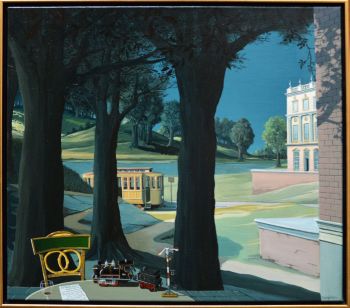
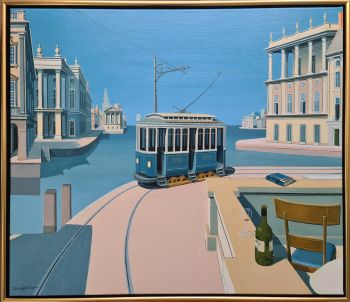
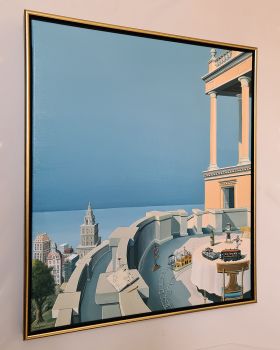
Albert Carel Willink (1900–1983) was one of the most important Dutch painters of the twentieth century and is internationally regarded as the grand master of magical realism. However, he himself preferred the terms imaginary realism or fantastic realism. His oeuvre is characterized by technically virtuosic paintings in which monumental architecture, classical sculptures, dramatic skies, and a sense of menace converge in an enigmatic, timeless world.
Willink was born on March 7, 1900, in Amsterdam. After brief studies in medicine and architecture in Delft, he decided to dedicate himself entirely to art and left for Berlin to pursue art education. In his early career, he experimented with various modern movements, including Constructivism, Cubism, and Futurism. A trip to Italy marked a decisive turning point in his development. There, he was deeply impressed by the metaphysical painting of Giorgio de Chirico. From the late 1920s onwards, he left abstraction behind and developed his characteristic, cool, and extremely precise realistic style. In his paintings, Willink created a unique visual world in which classical buildings, statues, deserted streets, exotic animals, and human figures appear in an unnatural and often ominous setting. His works exude a deep sense of melancholy, transience, and existential uncertainty. The threatening cloudscapes and carefully constructed compositions give his paintings a tension that is both fascinating and unsettling.
In addition to his imaginary landscapes, Willink was a highly sought-after portrait painter. Numerous prominent Dutch people, artists, businessmen, and members of the social elite had their portraits painted by him. His portraits combine almost photographic accuracy with subtle psychological depth.
Willink was also a well-known personality outside the art world. He was married four times and received considerable media attention in the 1970s due to his marriage to his extravagant third wife and muse, Mathilde Willink. Their striking appearances and turbulent relationship made them one of the most talked-about artistic couples in the Netherlands. After their divorce, Willink married artist Sylvia Quiël in 1977, who remained by his side until his death on October 19, 1983.
With his unparalleled technical mastery, mysterious visual language, and unique vision of reality, Albert Carel Willink is one of the most iconic artists in Dutch art history. His paintings remain admired worldwide for their perfect execution, psychological tension, and timeless, unsettling beauty.