Holy Land  by Abraham Ortelius
Scroll to zoom, click for slideshow

Holy Land 1595

Abraham Ortelius

€ 2.950

Inter-Antiquariaat Mefferdt & De Jonge

  • About the artwork
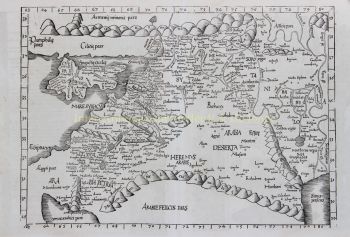
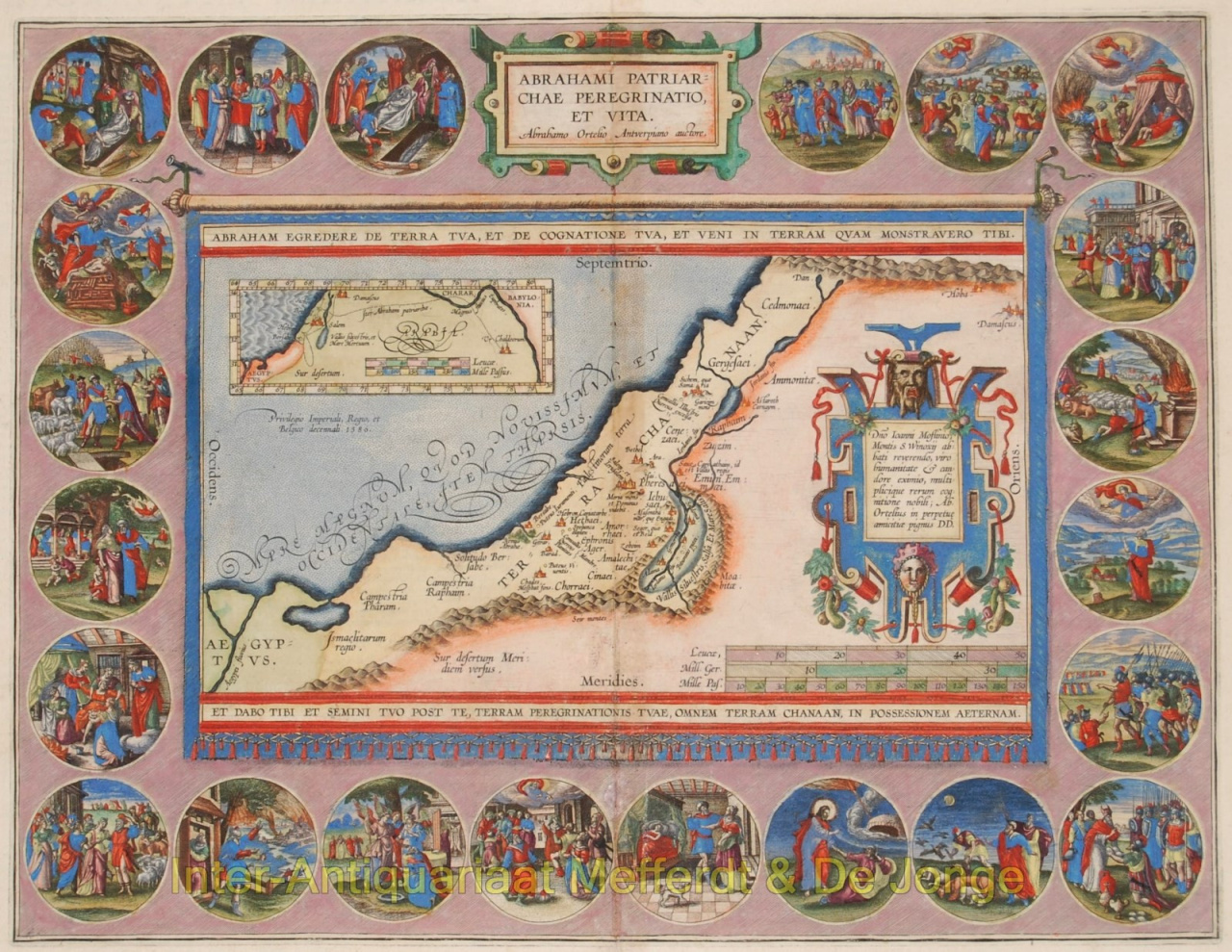
    HOLY LAND WITH THE WANDERINGS OF ABRAHAM IN BEAUTIFUL ORIGINAL COLOUR "Abrahami Patriarchae peregrinatio, et vita". Copper engraving published by Abraham Ortelius as part of his Theatrum Orbis Terrarum, in the (rare) Latin edition of 1595. Beautiful original hand colouring. Size: 35,3 x 46,6 cm. During the sixteenth century in the Low Countries, while Gerard Mercator was the preeminent cartographical innovator and draftsman, his friend and rival Abraham Ortelius became the most important map and atlas publisher. Ortelius' atlas Theatrum Orbis Terrarum, revolutionised geographical publishing. As he expanded it in subsequent editions, he included a number of maps important to the history of mapping the Holy Land; one of which being this beautiful map surrounded by vignettes of the life of the Patriarch Abraham. The map became part of the expanding supplement of historical maps, entitled the Parergon, that Ortelius appended to his atlas of modern maps. Largely the work of the master himself, the maps in the Parergon, and this one in particular, are the best engravings that reflect the widespread sixteenth-century interest in classical geography. Territorial divisions on the map are taken from the story Abraham in Genesis. Ancient tribal names are preserved in the regions of the Philistines, Amelechites, Jebusites, Cenezites, and Gergesites. The cities of Sodom and Gomorrah still thrive along the southern Jordan in the "Valley of the Forest of Salt", which was to become the Dead Sea. An inset shows the stages of the wanderings of Abraham, from Ur of the Chaldees, the lower Euphrates Valley, to Shechem, Bethel, Damascus, Egypt, and Hebron. In keeping with the title and biblical theme of the engraving, twenty-two medallions depicting scenes from the life of Abraham leaving Ur, sacrificing on the newly built altars at Shechem and Bethel, receiving the promise of the land, the birth of Isaac, the expulsion of Hagar, the sacrifice of Isaac, and the burials of Sarah and Abraham. The Wanderings of Abraham is among the most elaborate of Ortelius' compositions. It demonstrates his combined skills as a cartographer and an artist, and his accomplishment as an historian. Ortelius imaginatively enlivened the earliest period of biblical history for the readers of his Parergon. Price: Euro 2.950,-
  • About the artist

    Abraham Ortelius (1527–1598) was a Flemish cartographer and geographer who is widely regarded as the creator of the first modern atlas and one of the most influential mapmakers in history. His groundbreaking publication, Theatrum Orbis Terrarum (Theatre of the World), marked a turning point in the way geographical knowledge was collected, standardised and presented.

    First published in 1570, Theatrum Orbis Terrarum was revolutionary in both concept and execution. Unlike earlier collections of maps, Ortelius’s atlas offered a coherent and systematic overview of the known world, with maps of uniform size, style and quality, accompanied by scholarly commentary. This approach transformed cartography from a fragmented craft into a structured scientific and cultural discipline, making global geography accessible to scholars, merchants and statesmen alike.

    Ortelius lived and worked during the Golden Age of Netherlandish cartography, a period in which advances in exploration, printing and trade reshaped Europe’s understanding of the world. Alongside Gerardus Mercator, Ortelius is considered a founding father of the Netherlandish school of cartography. While Mercator revolutionised map projection, Ortelius excelled in synthesis—bringing together the best available geographical knowledge into a single, authoritative work.

    Beyond his technical achievements, Ortelius was a humanist thinker with a deep interest in history, classical antiquity and cultural exchange. He maintained an extensive international network of scholars, explorers and mapmakers, carefully crediting sources—an unusual and progressive practice for his time. This scholarly integrity contributed significantly to the credibility and enduring influence of his work.

    Abraham Ortelius’s legacy lies not only in his maps, but in his vision of the world as an interconnected whole. His atlas shaped European worldviews for generations and laid the foundations for modern cartography, securing his place as one of the great intellectual figures of the Renaissance.

Are you interested in buying this artwork?

Artwork details