Holy Land  by Abraham Ortelius
Scroll to zoom, click for slideshow

terre Sainte 1595

Abraham Ortelius

€ 2.950

Inter-Antiquariaat Mefferdt & De Jonge

  • Sur l'oeuvre d'art
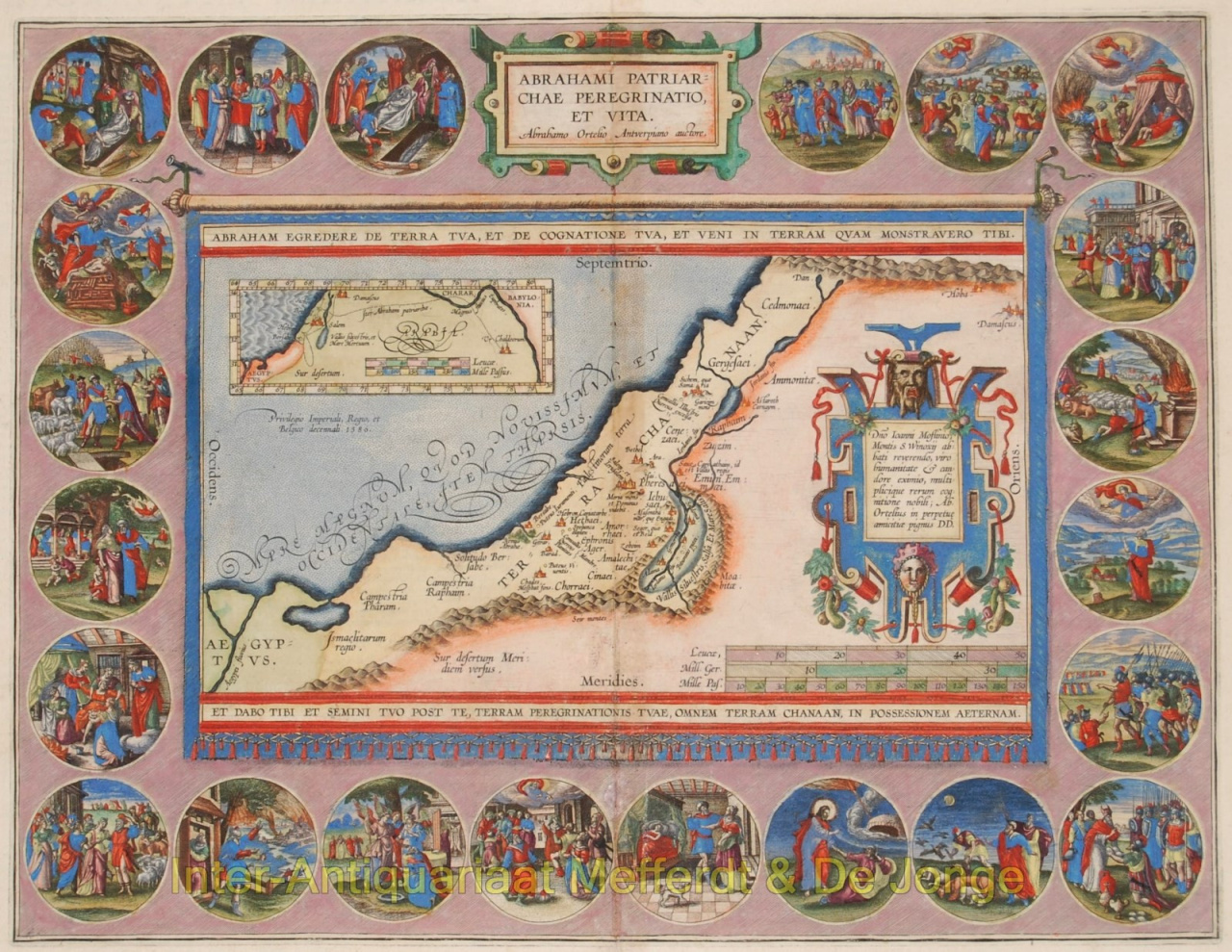
    HOLY LAND WITH THE WANDERINGS OF ABRAHAM IN BEAUTIFUL ORIGINAL COLOUR "Abrahami Patriarchae peregrinatio, et vita". Copper engraving published by Abraham Ortelius as part of his Theatrum Orbis Terrarum, in the (rare) Latin edition of 1595. Beautiful original hand colouring. Size: 35,3 x 46,6 cm. During the sixteenth century in the Low Countries, while Gerard Mercator was the preeminent cartographical innovator and draftsman, his friend and rival Abraham Ortelius became the most important map and atlas publisher. Ortelius' atlas Theatrum Orbis Terrarum, revolutionised geographical publishing. As he expanded it in subsequent editions, he included a number of maps important to the history of mapping the Holy Land; one of which being this beautiful map surrounded by vignettes of the life of the Patriarch Abraham. The map became part of the expanding supplement of historical maps, entitled the Parergon, that Ortelius appended to his atlas of modern maps. Largely the work of the master himself, the maps in the Parergon, and this one in particular, are the best engravings that reflect the widespread sixteenth-century interest in classical geography. Territorial divisions on the map are taken from the story Abraham in Genesis. Ancient tribal names are preserved in the regions of the Philistines, Amelechites, Jebusites, Cenezites, and Gergesites. The cities of Sodom and Gomorrah still thrive along the southern Jordan in the "Valley of the Forest of Salt", which was to become the Dead Sea. An inset shows the stages of the wanderings of Abraham, from Ur of the Chaldees, the lower Euphrates Valley, to Shechem, Bethel, Damascus, Egypt, and Hebron. In keeping with the title and biblical theme of the engraving, twenty-two medallions depicting scenes from the life of Abraham leaving Ur, sacrificing on the newly built altars at Shechem and Bethel, receiving the promise of the land, the birth of Isaac, the expulsion of Hagar, the sacrifice of Isaac, and the burials of Sarah and Abraham. The Wanderings of Abraham is among the most elaborate of Ortelius' compositions. It demonstrates his combined skills as a cartographer and an artist, and his accomplishment as an historian. Ortelius imaginatively enlivened the earliest period of biblical history for the readers of his Parergon. Price: Euro 2.950,-
  • Sur l'artiste

    Abraham Ortelius (1527-1598) était un cartographe et géographe flamand, considéré comme le créateur du premier atlas moderne et l'un des cartographes les plus influents de l'histoire. Son ouvrage novateur, le Theatrum Orbis Terrarum (Théâtre du Monde), a marqué un tournant dans la manière dont les connaissances géographiques étaient collectées, standardisées et présentées.

    Publié pour la première fois en 1570, le Theatrum Orbis Terrarum était révolutionnaire tant par son concept que par sa réalisation. Contrairement aux recueils de cartes antérieurs, l'atlas d'Ortelius offrait une vue d'ensemble cohérente et systématique du monde connu, avec des cartes de taille, de style et de qualité uniformes, accompagnées de commentaires érudits. Cette approche a transformé la cartographie, d'un art fragmenté, en une discipline scientifique et culturelle structurée, rendant la géographie mondiale accessible aux érudits, aux marchands et aux hommes d'État.

    Ortelius a vécu et travaillé pendant l'âge d'or de la cartographie néerlandaise, une période où les progrès de l'exploration, de l'imprimerie et du commerce ont profondément modifié la compréhension du monde en Europe. Avec Gerardus Mercator, Ortelius est considéré comme l'un des pères fondateurs de l'école néerlandaise de cartographie. Si Mercator a révolutionné la projection cartographique, Ortelius a excellé dans la synthèse, rassemblant les meilleures connaissances géographiques disponibles en une œuvre unique et faisant autorité.

    Au-delà de ses réalisations techniques, Ortelius était un humaniste passionné d'histoire, d'Antiquité classique et d'échanges culturels. Il entretenait un vaste réseau international d'érudits, d'explorateurs et de cartographes, citant scrupuleusement ses sources – une pratique inhabituelle et novatrice pour son époque. Cette rigueur scientifique a largement contribué à la crédibilité et à l'influence durable de son œuvre.

    L'héritage d'Abraham Ortelius réside non seulement dans ses cartes, mais aussi dans sa vision du monde comme un tout interconnecté. Son atlas a façonné la vision du monde européenne pendant des générations et a jeté les bases de la cartographie moderne, assurant à Ortelius une place parmi les grandes figures intellectuelles de la Renaissance.

Êtes-vous intéressé par l'achat de cette oeuvre?

Artwork details