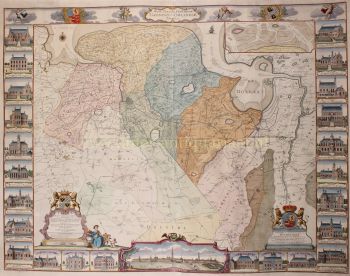
North Holland - Johannes Dou, 1729 by Johannes Dou
Scroll to zoom, click for slideshow

North Holland - Johannes Dou, 1729 1729

Johannes Dou

PapelImprimir
86 ⨯ 112 cm
€ 3.250

Inter-Antiquariaat Mefferdt & De Jonge

  • Sobre arte
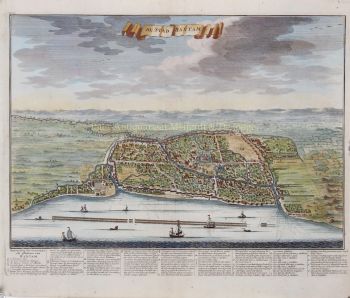
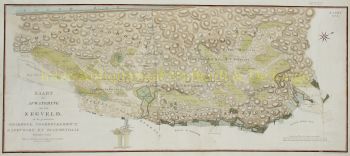
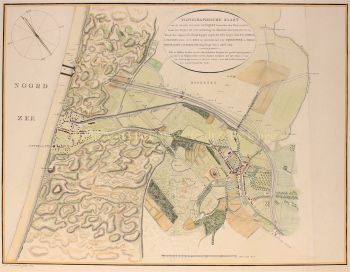
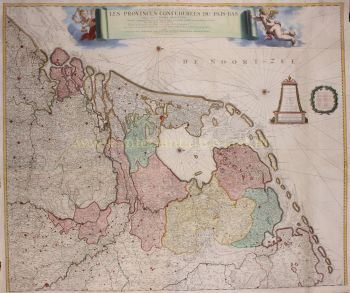
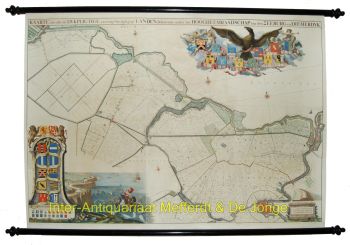
    WALL MAP OF NORTH HOLLAND “’T Hoogheemraadschap vande Uytwaterende Sluysen in Kennemerlant ende West-Frieslant” [The Hoogheemraadschap (water board) of Uitwaterende Sluizen in Kennemerland and West Friesland], copper engraving after the design of Johannes Dou I, published in Amsterdam by Andries and Hendrik de Leth in 1729. Coloured by a later hand. Four sheets joined. Size: 86 × 112 cm. This map is a characteristic example of Dutch water management cartography. To protect the low-lying Holland polderland — situated in a deep basin — from the waters of the sea and rivers, a large number of waterschappen (water boards) were established throughout western Netherlands, each responsible for hydraulic works and flood protection within its district. For efficient water management, accurate overview maps were of vital importance. The Dijkgraaf (dike reeve) and High Heemraden (board members) of the water board of the Uitwaterende Sluizen in Kennemerland and West Friesland commissioned the surveyor and mapmaker Johannes Dou I (1615–1682) to chart their jurisdiction in the northern part of Holland. Dou spent an astonishing twenty years on the project, completing in 1682 an enormous map composed of sixteen sheets. Two years later, a reduced version on four sheets was produced, as well as a smaller single-sheet edition. All three versions of the map were engraved by Koenraet Decker (1651–1709), a pupil of Romeyn de Hooghe and Abraham Deur. Although their names appear only on the sixteen-sheet edition, it has been shown that the copperplates were reused and copied multiple times, both individually and in sets of three maps. While the cartographic content remained unchanged, small variations can be found in the coats of arms of the water board officials. Based on the heraldry on this particular copy — those of Dijkgraaf Aris van der Mienden, and Hoogheemraden Gijsbert Ramp, Claas Swaan, Cornelis van Eyck, Adriaan Warmenhuisen, and Rentmeester en Secretaris (land agent and secretary) Johan Baert — we can date this example to 1729. Johannes Dou I was admitted as a land surveyor by the Hof van Holland (High Court of Holland) on 10 September 1635. He studied at the University of Leiden, and after his father’s death in 1635 he was appointed, together with Steven van Broeckhuysen, as permanent surveyor of the Hoogheemraadschap van Rijnland. From 1637 onwards he also practised as a notary public. Literature: o.a. Donkersloot - de Vrij, Topografische kaarten van Nederland vóór 1750, p. 147-148, no. 751. Price: Euro 3.250,-
  • Sobre artista

    Johannes Dou, também conhecido como Jan Jansz., ou Douw (Leiden, 7 de fevereiro de 1615 - 5 de março de 1682) foi um agrimensor que trabalhou principalmente para o Rijnland Water Board.

    Johannes Dou nasceu em Leiden em 1615 (de acordo com seu pai em 7 de fevereiro) como filho de Jan Pieterszoon Dou e Josina Sadelaer. Em 8 de março de 1634, Johannes foi matriculado na Universidade de Leiden como estudante de matemática.

    Ele assistiu a palestras com Frans van Schoten sr., professor de 'Duytsche mathematicque', o treinamento para engenheiros, construtores de fortalezas e agrimensores. Seu pai era um agrimensor proeminente com uma grande produção, que também publicou vários livros sobre seu campo.

    Provavelmente ensinou ao filho o que precisava na prática. De qualquer forma, em 10 de setembro de 1635, Johannes foi admitido pela Corte da Holanda para exercer a profissão de agrimensor. Em 1637 foi nomeado tabelião.

    Após a morte de seu pai em 1635, Dou foi nomeado juntamente com Steven van Broechuizen como agrimensor de Rijnland e a partir de 1637 também apareceu como notário em Leiden. Como seu pai, ele era extremamente produtivo, mas nunca atingiu sua estatura científica.

    Além de muitas pequenas encomendas, ele também se destacou com alguns trabalhos de bom gosto. Por exemplo, em 1661 ele projetou o canal de Leiden a Utrecht, foi implantado em 1672 durante a campanha contra os franceses e em 1675 completou seu grande mapa do Uitwaterende Sluizen.

Você está interessado em comprar esta obra de arte?

Artwork details