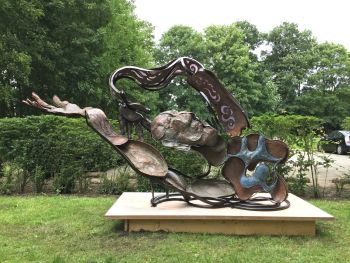
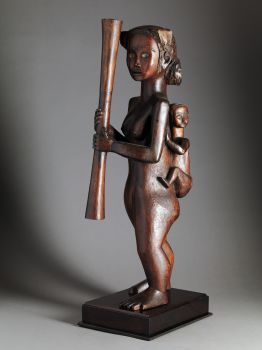
Sculptured model of a smoked Papua Mummie, papier mâché, 20th C 1990
Artista Sconosciuto
Cartapesta
76 ⨯ 40 ⨯ 60 cm
ConditionVery good
Prezzo su richiesta
Spectandum Gallery
- A proposito di opere d'arteBurial practices in New Guinea, as elsewhere in the world, differ across cultures. In some traditions, the way a body is treated after death is believed to directly impact the soul's journey.In Irian Jaya (the Indonesian region of Papua New Guinea), five tribes have a unique tradition of mummification: the Mek tribe of the Bintang Mountains, the Dani tribe from the Baliem Valley, the Moni tribe in Intan Jaya, the Yali tribe in Kurima, and the Mee tribe in Dogiyai. Unlike the well-known Egyptian mummies, these mummies are not preserved in coffins or wrapped in bandages, but are instead kept intact, with a distinctive dark coloration.Mummification is reserved for individuals of great importance within these tribes, such as tribal leaders, war commanders, or highly respected figures. The process involves several stages, beginning with the selection of tribe members to handle the mummification. Firewood is gathered, and a traditional Papuan house known as a honai is prepared for the ceremony. The body is then smoked over a fire, a method that helps preserve it.After smoking, a series of rituals are performed, during which the mummy is adorned with feathers, pig tusks, and a traditional gourd worn as a covering. The process concludes with a stone-burning feast known as barapen.Papuan mummies are typically positioned in a sitting posture, a reflection of ancient beliefs that associate this stance with the fetal position, symbolizing rebirth. To date, six mummies have been documented in Papua: four from the Dani tribe, one from the Yali tribe, and one from the Moni tribe. Each tribe has specific names for their mummies, such as the Kurulu, Pumo, Araboda, and Jiwika mummies from the Dani people of Wamena.These mummies are regarded as symbols of blessings for the community. The practice of mummification is seen as a way to honor and preserve the memory of esteemed individuals while maintaining cultural traditions.
- A proposito di opere artista
Può succedere che un artista o un creatore sia sconosciuto.
Alcune opere non sono determinate da chi sono state realizzate o sono state realizzate da (un gruppo di) artigiani. Esempi sono statue dell'antichità, mobili, specchi o firme non chiare o leggibili ma anche alcune opere non sono affatto firmate.
Inoltre puoi trovare la seguente descrizione:
•"Attribuito a …." A loro avviso probabilmente opera dell'artista, almeno in parte
•“Studio di ….” o “Officina di” A loro avviso un'opera eseguita nello studio o nella bottega dell'artista, eventualmente sotto la sua supervisione
•“Cerchio di…” A loro avviso un'opera del periodo dell'artista che mostra la sua influenza, strettamente legata all'artista ma non necessariamente al suo allievo
•"Stile di..." o "Seguace di..." A loro avviso un'opera eseguita nello stile dell'artista ma non necessariamente da un allievo; può essere contemporaneo o quasi contemporaneo
•“Modalità di…” A loro avviso un'opera nello stile dell'artista ma di epoca successiva
•"Dopo …." A loro avviso una copia (di qualsiasi data) di un'opera dell'artista
•“Firmato…”, “Datato…” o “Iscritto” A loro avviso l'opera è stata firmata/datata/inscritta dall'artista. L'aggiunta di un punto interrogativo indica un elemento di dubbio
•"Con firma....", "Con data...", "Con iscrizione..." o “Riporta firma/data/iscrizione” a loro avviso la firma/data/iscrizione è stata aggiunta da qualcuno diverso dall'artista
Sei interessato ad acquistare questa opera d'arte?
Artwork details
Related artworks
Artista Sconosciuto
Set Arita 'dog training' plates, 18th century 1700 - 1730
Prezzo su richiestaVerkoulen Oriental & European Antiques
1 - 4 / 12Artista Sconosciuto
Antica icona russa in legno: Arcangelo Gabrieleearly 17th
Prezzo su richiestaKunsthandel H.W.C. Dullaert Icons
1 - 4 / 24Shinkichi Tajiri
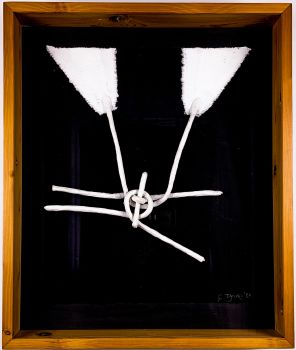
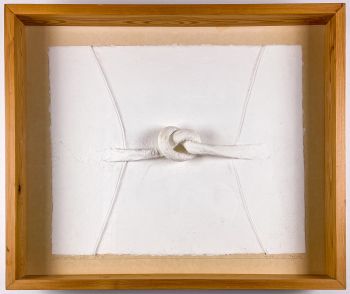
“Koan” 1988 – papier-mâché / cotton on paper, original frame1988
Prezzo su richiestaVan Kerkhoff Art
1 - 4 / 6Artista Sconosciuto
17th C representation of the Roof of Folly: An Allegory of the Fall, German School.1670 - 1685
Prezzo su richiestaSpectandum Gallery
Artista Sconosciuto
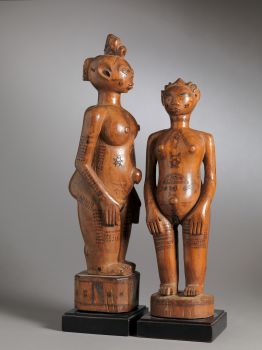
Couple Wooden Ancestors Sculptures with Scarifications, Zela People, DRC. 1920 - 1930
Prezzo su richiestaSpectandum Gallery
Artista Sconosciuto
19th C SCALED MODEL OF A CHINESE WORKSHOP WITH 17 POLYCHROMES TERRACOTTA FIGURES1880 - 1900
Prezzo su richiestaSpectandum Gallery
1 - 4 / 12