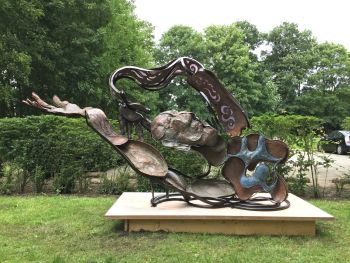
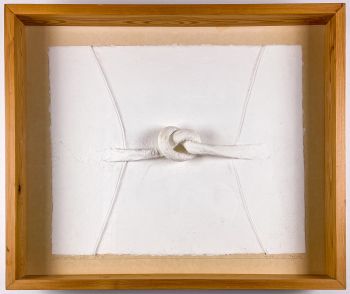
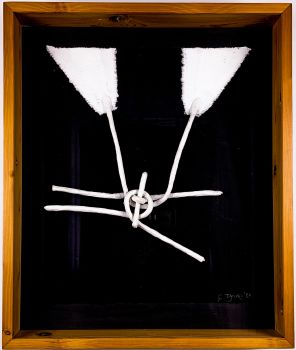
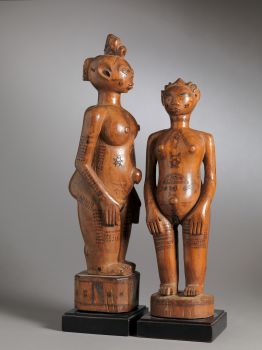
Sculptured model of a smoked Papua Mummie, papier mâché, 20th C 1990
Artista Desconhecido
Papier mache
76 ⨯ 40 ⨯ 60 cm
ConditionVery good
Preço em pedido
Spectandum Gallery
- Sobre arteBurial practices in New Guinea, as elsewhere in the world, differ across cultures. In some traditions, the way a body is treated after death is believed to directly impact the soul's journey.In Irian Jaya (the Indonesian region of Papua New Guinea), five tribes have a unique tradition of mummification: the Mek tribe of the Bintang Mountains, the Dani tribe from the Baliem Valley, the Moni tribe in Intan Jaya, the Yali tribe in Kurima, and the Mee tribe in Dogiyai. Unlike the well-known Egyptian mummies, these mummies are not preserved in coffins or wrapped in bandages, but are instead kept intact, with a distinctive dark coloration.Mummification is reserved for individuals of great importance within these tribes, such as tribal leaders, war commanders, or highly respected figures. The process involves several stages, beginning with the selection of tribe members to handle the mummification. Firewood is gathered, and a traditional Papuan house known as a honai is prepared for the ceremony. The body is then smoked over a fire, a method that helps preserve it.After smoking, a series of rituals are performed, during which the mummy is adorned with feathers, pig tusks, and a traditional gourd worn as a covering. The process concludes with a stone-burning feast known as barapen.Papuan mummies are typically positioned in a sitting posture, a reflection of ancient beliefs that associate this stance with the fetal position, symbolizing rebirth. To date, six mummies have been documented in Papua: four from the Dani tribe, one from the Yali tribe, and one from the Moni tribe. Each tribe has specific names for their mummies, such as the Kurulu, Pumo, Araboda, and Jiwika mummies from the Dani people of Wamena.These mummies are regarded as symbols of blessings for the community. The practice of mummification is seen as a way to honor and preserve the memory of esteemed individuals while maintaining cultural traditions.
- Sobre artista
Pode acontecer que um artista ou criador seja desconhecido.
Algumas obras não devem ser determinadas por quem são feitas ou são feitas por (um grupo de) artesãos. Exemplos são estátuas dos tempos antigos, móveis, espelhos ou assinaturas que não são claras ou legíveis, mas também algumas obras não são assinadas.
Além disso, você pode encontrar a seguinte descrição:
•"Atribuído a …." Na opinião deles, provavelmente uma obra do artista, pelo menos em parte
• “Estúdio de…” ou “Oficina de” Em sua opinião um trabalho executado no estúdio ou oficina do artista, possivelmente sob sua supervisão
• "Círculo de ..." Na opinião deles, uma obra da época do artista mostrando sua influência, intimamente associada ao artista, mas não necessariamente seu aluno
•“Estilo de…” ou “Seguidor de…” Na opinião deles, um trabalho executado no estilo do artista, mas não necessariamente por um aluno; pode ser contemporâneo ou quase contemporâneo
• "Maneira de ..." Na opinião deles, uma obra no estilo do artista, mas de data posterior
•"Depois …." Na opinião deles uma cópia (de qualquer data) de uma obra do artista
• “Assinado…”, “Datado…” ou “Inscrito” Na opinião deles, a obra foi assinada/datada/inscrita pelo artista. A adição de um ponto de interrogação indica um elemento de dúvida
• "Com assinatura ….”, “Com data ….”, “Com inscrição ….” ou “Tem assinatura/data/inscrição” na opinião deles a assinatura/data/inscrição foi adicionada por outra pessoa que não o artista

Você está interessado em comprar esta obra de arte?
Artwork details
Related artworks
- 1 - 4 / 12
Artista Desconhecido
Chinese gilt bronze censer, Xuande mark, 18th century, Qing dynasty18th century
Preço em pedidoMenken Works of Art
Artista Desconhecido
Ícone russo representando um Deesis estendido1600 - 1650
Preço em pedidoKunsthandel H.W.C. Dullaert Icons
1 - 4 / 24- 1 - 4 / 6
- 1 - 4 / 12