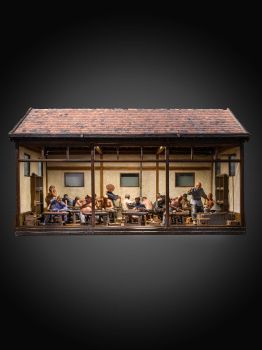
Sculptured model of a smoked Papua Mummie, papier mâché, 20th C 1990
Artiste Inconnu
Papier maché
76 ⨯ 40 ⨯ 60 cm
ConditionVery good
Prix sur demande
Spectandum Gallery
- Sur l'oeuvre d'artBurial practices in New Guinea, as elsewhere in the world, differ across cultures. In some traditions, the way a body is treated after death is believed to directly impact the soul's journey.In Irian Jaya (the Indonesian region of Papua New Guinea), five tribes have a unique tradition of mummification: the Mek tribe of the Bintang Mountains, the Dani tribe from the Baliem Valley, the Moni tribe in Intan Jaya, the Yali tribe in Kurima, and the Mee tribe in Dogiyai. Unlike the well-known Egyptian mummies, these mummies are not preserved in coffins or wrapped in bandages, but are instead kept intact, with a distinctive dark coloration.Mummification is reserved for individuals of great importance within these tribes, such as tribal leaders, war commanders, or highly respected figures. The process involves several stages, beginning with the selection of tribe members to handle the mummification. Firewood is gathered, and a traditional Papuan house known as a honai is prepared for the ceremony. The body is then smoked over a fire, a method that helps preserve it.After smoking, a series of rituals are performed, during which the mummy is adorned with feathers, pig tusks, and a traditional gourd worn as a covering. The process concludes with a stone-burning feast known as barapen.Papuan mummies are typically positioned in a sitting posture, a reflection of ancient beliefs that associate this stance with the fetal position, symbolizing rebirth. To date, six mummies have been documented in Papua: four from the Dani tribe, one from the Yali tribe, and one from the Moni tribe. Each tribe has specific names for their mummies, such as the Kurulu, Pumo, Araboda, and Jiwika mummies from the Dani people of Wamena.These mummies are regarded as symbols of blessings for the community. The practice of mummification is seen as a way to honor and preserve the memory of esteemed individuals while maintaining cultural traditions.
- Sur l'artiste
Il peut arriver qu'un artiste ou un créateur soit inconnu.
Certaines œuvres ne doivent pas être déterminées par qui elles sont faites ou elles sont faites par (un groupe d') artisans. Les exemples sont des statues de l'Antiquité, des meubles, des miroirs ou des signatures qui ne sont pas claires ou lisibles, mais aussi certaines œuvres ne sont pas signées du tout.
Vous pouvez également trouver la description suivante :
•"Attribué à …." A leur avis probablement une oeuvre de l'artiste, au moins en partie
•« Atelier de …. ou « Atelier de » À leur avis, une œuvre exécutée dans l'atelier ou l'atelier de l'artiste, éventuellement sous sa direction
•« Cercle de… ». A leur avis une oeuvre de la période de l'artiste témoignant de son influence, étroitement associée à l'artiste mais pas forcément son élève
•« Style de … ». ou "Suiveur de ...." Selon eux, une œuvre exécutée dans le style de l'artiste mais pas nécessairement par un élève ; peut être contemporain ou presque contemporain
•« Manière de… ». A leur avis une oeuvre dans le style de l'artiste mais d'une date plus tardive
•"Après …." A leur avis une copie (quelle qu'en soit la date) d'une oeuvre de l'artiste
•« Signé… », « Daté… ». ou « Inscrit » À leur avis, l'œuvre a été signée/datée/inscrite par l'artiste. L'ajout d'un point d'interrogation indique un élément de doute
• "Avec signature ….", "Avec date ….", "Avec inscription …." ou "Porte signature/date/inscription" à leur avis la signature/date/inscription a été ajoutée par quelqu'un d'autre que l'artiste

Êtes-vous intéressé par l'achat de cette oeuvre?
Artwork details
Related artworks
- 1 - 4 / 12
Artiste Inconnu
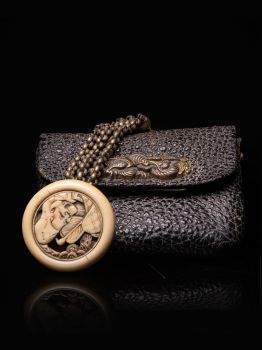
A white jade ‘Lotus Seedpod and Bug’ carving, Qing dynasty, 18th century18th century
Prix sur demandeMenken Works of Art
1 - 4 / 24- 1 - 4 / 6
Artiste Inconnu
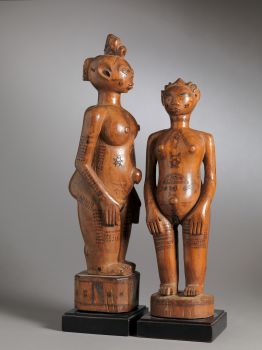
Couple Wooden Ancestors Sculptures with Scarifications, Zela People, DRC. 1920 - 1930
Prix sur demandeSpectandum Gallery
Artiste Inconnu
MATERNITY FIGURE, FANG-MABEA, CAMEROON.PROVENANCE R.CAILLOIS-P.RATTON.1920 - 1930
Prix sur demandeSpectandum Gallery
1 - 4 / 12