About the artist
Qassim Alsaedy was born in Baghdad in 1949 and grew up in a time of cultural flourishing and political unrest. From an early age, his life was marked by a deep commitment to art, language and resistance. His artistic development began in Iraq, where he trained at the Institute of Fine Arts in Baghdad. In those early years, his work was imbued with symbolism, characterized by the use of archaic scripts, abstract forms and references to the Mesopotamian heritage.
Alsaedy's life took a drastic turn when he was imprisoned and tortured for his political beliefs under the regime of Saddam Hussein. That period, characterized by silence, isolation and inner strength, left an indelible mark on his art. In prison, he scratched signs into the walls – an act that would later become a recurring motif in his paintings and installations: traces of existence, communication under pressure, survival through creation.
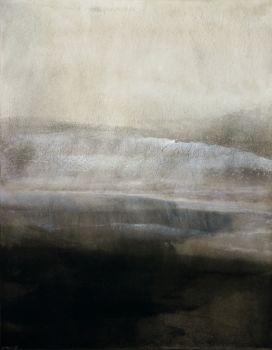
After his release, Alsaedy fled to Europe in the 1980s. He eventually settled in the Netherlands, where he continued his studies at the Gerrit Rietveld Academy in Amsterdam. His work evolved during this period into a powerful synthesis of personal history, collective memory and aesthetic austerity. He developed his own visual language in which subdued earth tones, textures of rust, sand and scratches merge with calligraphic elements and reliefs. His canvases often resemble weathered walls, secret documents or archaeological finds, loaded with stories without words.
Qassim Alsaedy's work has been exhibited in numerous galleries and museums in Europe and the Middle East. Yet his artistry remains strongly rooted in the personal: every line, every scratch, every mark refers to the unspoken layers of experience, loss, hope and memory. His art invites silence and reflection, as a form of inner archaeology. In a world full of noise and speed, Alsaedy continues to search for silence, truth and the echo of human existence.
Artworks
Filter Artworks
1 artwork for sale by Qassim Alsaedy

Related artworks for sale






Nick Veasey
1955 Mercedes 300SL Gull-Wing (Edition of 25)2015 - 2020
Price on requestVilla del Arte Galleries