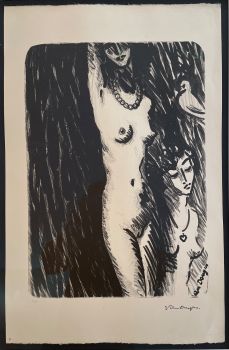
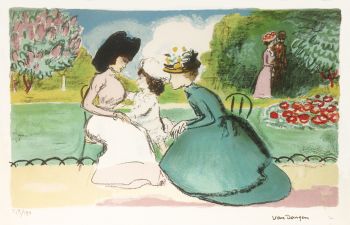
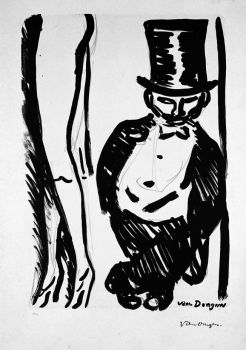
The lithography shows a ethnical woman sitting quite relax and with a smile on a bed. She’s wearing loose fitting robes and a tulle band wrapped around her head, the beaded necklace she is wearing is visible from afar. Her right foot is resting on the edge of the bed with her right hand resting nonchalant on her knee. The left foot is on the floor and still has the orange shoe on. It’s not clear if the woman is wearing sunglasses or if her eyes are just not sketched very detailed. The setting is not clear weather it’s inside or outside. The sketch is both signed and dated. The frame is included. Kees van Dongen (1877 – 1968) was a Dutch-French painter who was one of the leading Fauves. Van Dongen’s early work was influenced by The Hague School and symbolism and it evolved gradually into a rough pointillist style. This sketch is signed in the right-hand corner. The sketch is probably made of charcoal on paper and is in good condition and framed.
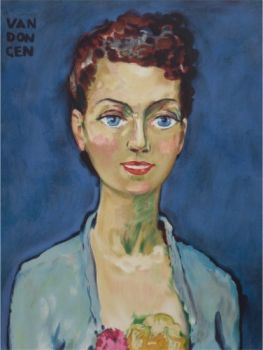
Kees (Cornelis) Theodorus Marie van Dongen nasceu em 26 de janeiro de 1877 em Delfshaven, nos arredores de Rotterdam, Holanda. Kees van Dongen é um pintor francês nascido na Holanda, um dos principais fauvistas depois de Henri Matisse, particularmente conhecido por seus retratos de mulheres sensualmente esguios.
Ele frequentou a Royal Academy of Fine Arts de Rotterdam, trabalhando com J. Striening e J.G. Heyberg, e mudou-se para Paris aos 20 anos. Fauvist Tendo conhecido Matisse, ele participou em 1905 no famoso Salon d'Automne, no qual o grupo Fauve (Besta Selvagem) recebeu o seu epíteto. Em 1907 ele foi contratado por Daniel Henry Kahnweiler, o negociante de Picasso, e sua reputação cresceu.
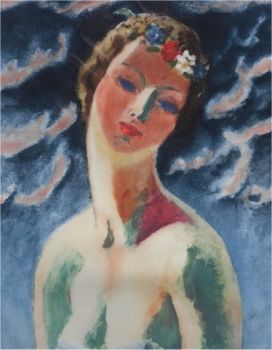
Em 1908 foi convidado a integrar o grupo expressionista alemão Die Brücke (A Ponte), então centrado em Dresden. O estilo sincero e colorido do retrato de Paris Kees van Dongen estava imensamente na moda no final da Grande Guerra (1914-1918). A figura da mulher magra, de lábios vermelhos e inconfundivelmente aristocrática (como em Mulher com joias, 1905) tornou-se seu arquétipo assustador.
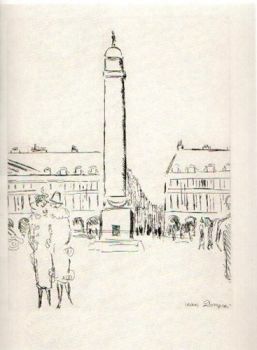
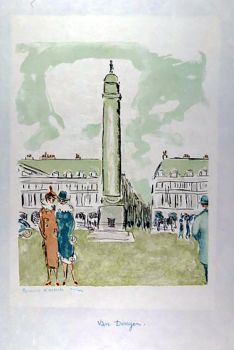
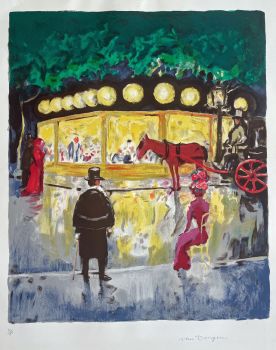
Seu retrato de Anatole France (1917) é particularmente notável. Ele também pintou várias paisagens marinhas ricamente coloridas e cenas de Paris em um estilo seguro e econômico. Além de vender suas pinturas, van Dongen também ganhou uma renda vendendo esquetes satíricos para o jornal Revue Blanche. Ele também organizou bailes à fantasia de muito sucesso em Montparnasse, para os quais as pessoas pagavam entrada, para obter uma renda extra.
A partir de 1959, Kees van Dongen morou em Mônaco. Ele morreu em sua casa em Monte Carlo em 1968. Uma extensa coleção de obras de van Dongen é mantida pelo Novo Museu Nacional de Mônaco.
Você está interessado em comprar esta obra de arte?