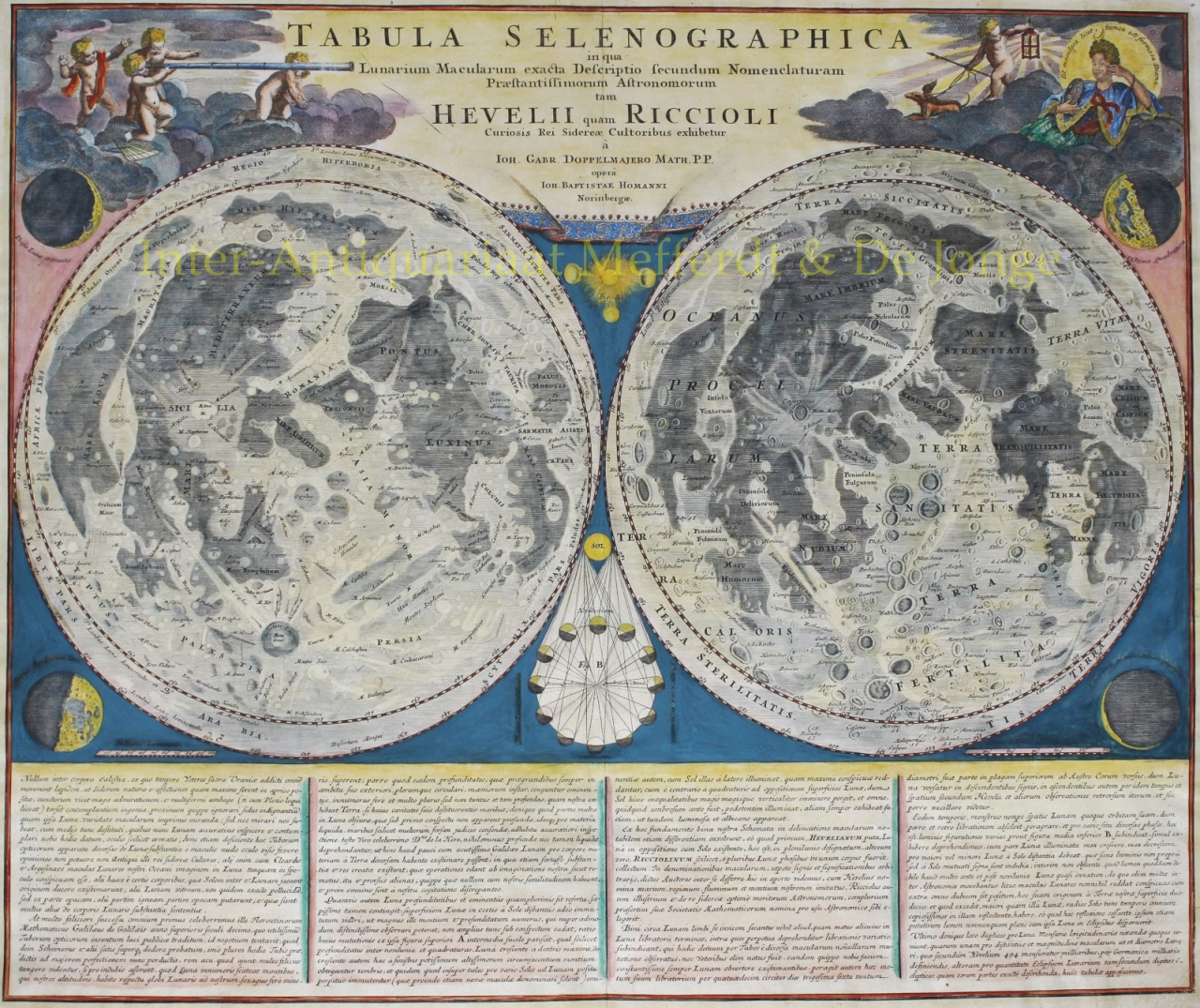
Map of the moon  by Johann Baptist Homann
Scroll to zoom, click for slideshow

Mappa della luna 1742 - 1748

Johann Baptist Homann

€ 1.950

Inter-Antiquariaat Mefferdt & De Jonge

  • A proposito di opere d'arte
    IMPORTANT MAP OF THE MOON “Tabula Selenographica in qua Lunarium Macularum exacta Descriptio secundum Nomenclaturam … Hevelii quam Riccioli”. Copper engraving made by Johann Baptist Homann after Johann Gabriel Doppelmayr, from the Atlas Coelestis in quo Mundus Spectabilis published in Nuremberg in 1742 or 1748. Coloured by a later hand. Size c. 48,5 x 58 cm. The left hand lunar map, composed by Johannes Hevelius, is a considered a foundational map in the science of Selenography – or lunar cartography. This map first appeared in Hevelius’ 1647 work Selenographia which laid the groundwork for most subsequent lunar cartographic studies. Here the moon is presented as it can never be seen from Earth, at a greater than 360 degrees and with all visible features given equal weight. In this map Hevelius also establishes the convention of mapping the lunar surface as if illuminated from a single source – in this case morning light. The naming conventions he set forth, which associate lunar features with terrestrial locations such as “Asia Minor”, “Persia”, “Sicilia”, etc. were popular until the middle of the 18th century when Giovanni Battista Riccioli’s nomenclature took precedence. The Riccioli map, on the right, is more properly known as the Riccioli-Grimaldi map, after fellow Jesuit Francesco Grimaldi with whom Riccioli composed the chart. This map first appeared in Riccioli and Grimaldi’s 1651 Almagestum Novum. This was a significant lunar chart and offered an entirely new nomenclature which, for the most part, is still in use today. Curiously, though Riccioli, as a devout Jesuit, composed several treatises denouncing Copernican theory, he chose to name one of the Moon’s most notable features after the astronomer – perhaps suggesting that he was a secret Copernicus sympathizer? Other well-known lunar features named by Riccioli include the Sea of Tranquility where Apollo 11 landed and where Neil Armstrong became the first human to set foot on the moon’s surface 50 years ago. The upper left and right hand quadrants feature decorative allegorical cartouche work that include images of putti looking through a telescope and a representation of the ancient Greek Moon goddess Selene. Additional smaller maps show the moon in various phases of its monthly cycle. Below the map proper extensive Latin text discusses Selenography. This map first appeared Johann Baptist Homann’s 1707 Neuer Atlas and was later reissued as plate no. 11 in Doppelmayr’s important 1742 Atlas Coelestis, which was also published by Homann. Price: 1.950,-
  • A proposito di opere artista

    Johann Baptist Homann (1664–1724) fu un importante cartografo, incisore ed editore tedesco dell'inizio del XVIII secolo, ampiamente considerato uno dei cartografi più influenti del suo tempo. Nato a Oberkammlach, in Baviera, frequentò inizialmente una scuola gesuita prima di convertirsi al protestantesimo, una decisione che avrebbe plasmato sia il suo percorso personale che professionale.Johann Baptist Homann (1664–1724) fu un importante cartografo, incisore ed editore tedesco dell'inizio del XVIII secolo, ampiamente considerato uno dei cartografi più influenti del suo tempo. Nato a Oberkammlach, in Baviera, frequentò inizialmente una scuola gesuita prima di convertirsi al protestantesimo, una decisione che avrebbe plasmato sia il suo percorso personale che professionale.

    Homann iniziò la sua carriera come notaio a Norimberga nel 1687, ma ben presto si dedicò all'incisione e alla cartografia, spinto da un crescente interesse per la geografia e la rappresentazione visiva della conoscenza. Dopo un periodo formativo a Vienna tra il 1693 e il 1695, tornò a Norimberga, dove fondò la sua casa editrice nel 1702. Questo segnò l'inizio di una carriera estremamente produttiva e influente.
    Le sue mappe si distinsero rapidamente per la precisione, la chiarezza e la ricchezza decorativa, combinando il rigore scientifico con elaborate ornamentazioni barocche. La reputazione di Homann gli valse la nomina a Geografo Imperiale da parte dell'imperatore Carlo VI nel 1715, e in seguito fu eletto membro dell'Accademia Prussiana delle Scienze di Berlino, un riconoscimento del suo contributo al progresso delle conoscenze geografiche.

    Nel 1716, Homann pubblicò la sua opera più celebre, il Grosser Atlas über die ganze Welt (Grande Atlante del Mondo), una raccolta completa e ambiziosa di mappe che consolidò la sua eredità. Molte di queste opere furono realizzate in collaborazione con l'incisore Christoph Weigel il Vecchio. Attraverso la sua casa editrice e la sua produzione cartografica, Homann svolse un ruolo centrale nell'affermare Norimberga come importante centro di produzione cartografica in Europa.

Sei interessato ad acquistare questa opera d'arte?

Artwork details