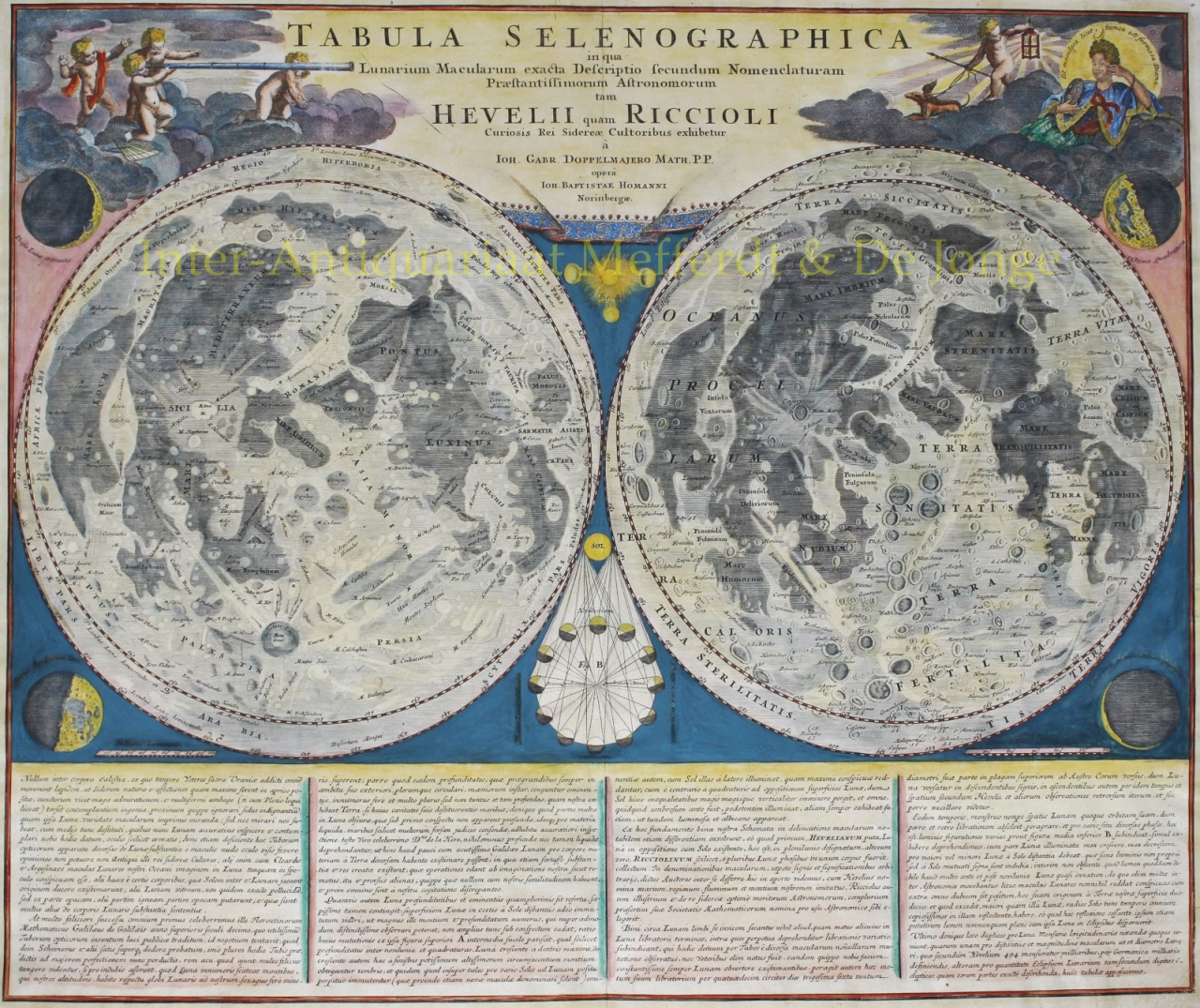
Map of the moon  by Johann Baptist Homann
Scroll to zoom, click for slideshow

Carte de la lune 1742 - 1748

Johann Baptist Homann

€ 1.950

Inter-Antiquariaat Mefferdt & De Jonge

  • Sur l'oeuvre d'art
    IMPORTANT MAP OF THE MOON “Tabula Selenographica in qua Lunarium Macularum exacta Descriptio secundum Nomenclaturam … Hevelii quam Riccioli”. Copper engraving made by Johann Baptist Homann after Johann Gabriel Doppelmayr, from the Atlas Coelestis in quo Mundus Spectabilis published in Nuremberg in 1742 or 1748. Coloured by a later hand. Size c. 48,5 x 58 cm. The left hand lunar map, composed by Johannes Hevelius, is a considered a foundational map in the science of Selenography – or lunar cartography. This map first appeared in Hevelius’ 1647 work Selenographia which laid the groundwork for most subsequent lunar cartographic studies. Here the moon is presented as it can never be seen from Earth, at a greater than 360 degrees and with all visible features given equal weight. In this map Hevelius also establishes the convention of mapping the lunar surface as if illuminated from a single source – in this case morning light. The naming conventions he set forth, which associate lunar features with terrestrial locations such as “Asia Minor”, “Persia”, “Sicilia”, etc. were popular until the middle of the 18th century when Giovanni Battista Riccioli’s nomenclature took precedence. The Riccioli map, on the right, is more properly known as the Riccioli-Grimaldi map, after fellow Jesuit Francesco Grimaldi with whom Riccioli composed the chart. This map first appeared in Riccioli and Grimaldi’s 1651 Almagestum Novum. This was a significant lunar chart and offered an entirely new nomenclature which, for the most part, is still in use today. Curiously, though Riccioli, as a devout Jesuit, composed several treatises denouncing Copernican theory, he chose to name one of the Moon’s most notable features after the astronomer – perhaps suggesting that he was a secret Copernicus sympathizer? Other well-known lunar features named by Riccioli include the Sea of Tranquility where Apollo 11 landed and where Neil Armstrong became the first human to set foot on the moon’s surface 50 years ago. The upper left and right hand quadrants feature decorative allegorical cartouche work that include images of putti looking through a telescope and a representation of the ancient Greek Moon goddess Selene. Additional smaller maps show the moon in various phases of its monthly cycle. Below the map proper extensive Latin text discusses Selenography. This map first appeared Johann Baptist Homann’s 1707 Neuer Atlas and was later reissued as plate no. 11 in Doppelmayr’s important 1742 Atlas Coelestis, which was also published by Homann. Price: 1.950,-
  • Sur l'artiste

    Johann Baptist Homann (1664-1724) fut un cartographe, graveur et éditeur allemand de premier plan du début du XVIIIe siècle, considéré comme l'un des cartographes les plus influents de son temps. Né à Oberkammlach en Bavière, il fit ses premières études dans une école jésuite avant de se convertir au protestantisme – une décision qui allait marquer son parcours personnel et professionnel.Johann Baptist Homann (1664-1724) fut un cartographe, graveur et éditeur allemand de premier plan du début du XVIIIe siècle, considéré comme l'un des cartographes les plus influents de son temps. Né à Oberkammlach en Bavière, il fit ses premières études dans une école jésuite avant de se convertir au protestantisme – une décision qui allait marquer son parcours personnel et professionnel.

    Homann commença sa carrière comme notaire à Nuremberg en 1687, mais se tourna rapidement vers la gravure et la cartographie, animé par un intérêt croissant pour la géographie et la représentation visuelle du savoir. Après une période formatrice à Vienne entre 1693 et ​​1695, il retourna à Nuremberg, où il fonda sa propre maison d'édition en 1702. Ce fut le début d'une carrière extrêmement productive et influente.
    Ses cartes furent rapidement reconnues pour leur précision, leur clarté et leur richesse décorative, alliant rigueur scientifique et ornementation baroque élaborée. La réputation d'Homann lui valut d'être nommé géographe impérial par l'empereur Charles VI en 1715, puis élu à l'Académie prussienne des sciences de Berlin, en reconnaissance de sa contribution au progrès des connaissances géographiques.

    En 1716, Homann publia son œuvre la plus célèbre, le Grosser Atlas über die ganze Welt (Grand Atlas du monde), un recueil de cartes ambitieux et exhaustif qui consolida sa réputation. Nombre de ces ouvrages furent réalisés en collaboration avec le graveur Christoph Weigel l'Ancien. Par sa maison d'édition et sa production cartographique, Homann joua un rôle central dans l'établissement de Nuremberg comme centre majeur de production cartographique en Europe.

Êtes-vous intéressé par l'achat de cette oeuvre?

Artwork details