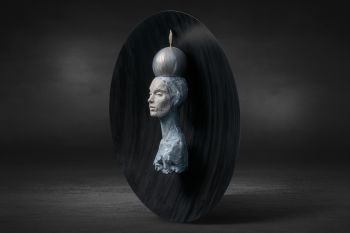
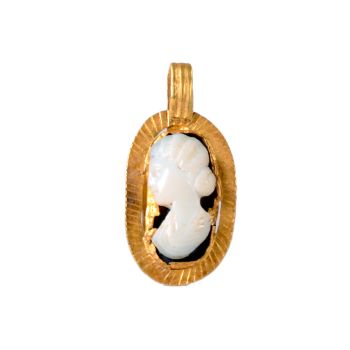
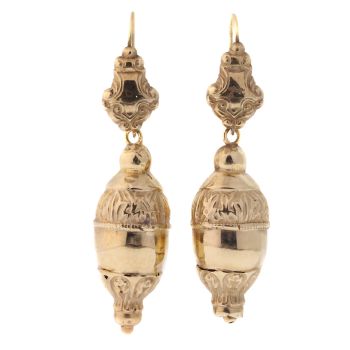
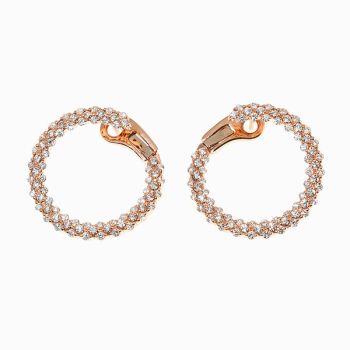
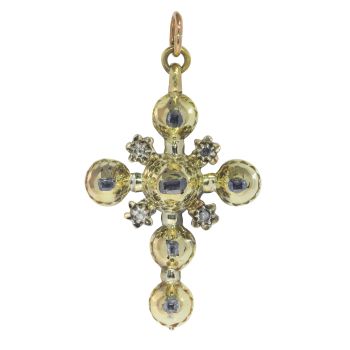
Likely crafted in the late 16th to early 17th century, this devotional pendant evokes both awe and quiet grace. The enameled face of Christ, resting with eyes closed upon banded agate, is framed by a fine radiating halo and twisted gold border—detailsso delicately rendered they seem to hush the room. Its expression carries a tender solemnity, heightened by the golden tear beneath one eye. Thought to be of South Netherlandish or German origin, the piece transcends its time. A true museum-worthyjewel—yet still something one can hold, wear, and cherish across generations.
Antique jewelry object group
pendant
Condition
very good condition
more info on our condition scale
Possible Origin & Craftsmanship
While the precise provenance is unknown, stylistic features such as the twisted gold framing, enamel detailing, and devotional subject suggest a South Netherlandish or German origin. Such pendants were often privately commissioned and treasured for boththeir spiritual and artistic value. unknown
Style
Renaissance - The Renaissance (from the Italian Rinascimento, meaning “rebirth”) was a cultural awakening that began in 14th-century Florence and gradually swept across Europe. It marked a revival of classical ideals, inspiring artists, scholars andcraftsmen to draw on the harmony and refinement of ancient Greece and Rome. Often seen as the bridge between the medieval world and the modern age, the Renaissance gave rise to astonishing innovations in art, architecture and learning. Its spirit ofcuriosity and elegance lives on in objects such as this jewel—where craftsmanship meets humanist sensibility. See also: Renaissance jewellery and Classicism, the measured application of ancient principles in design, celebrated for its restraint, balance and timeless beauty.
more info on styles
Style specifics
This pendant embodies the intimate side of Renaissance art—where devotion, symbolism and craftsmanship come together in miniature form. Unlike grandiose court jewels, this type of object was likely meant for private contemplation. The restrained palette, expressive enamelled features, and refined goldwork reflect the Renaissance fascination with classical serenity and spiritual grace. Particularly telling is the use of white enamel accented with black: a stylistic choice often seen in late 16th- to early 17th-century devotional jewellery, evoking purity, solemnity, and emotional depth.
Period
ca. 1600
Events & facts of this era, poetry of this era, fashion of this era.
Source of inspiration
Christianity
Theme
The pendant depicts the head of Christ with closed eyes, a subtle golden tear beneath his left eye, and a radiating halo that encircles the image like a crown of quiet light. The expression is one of stillness and surrender—capturing not just a religious icon, but a deeply human moment of suffering and grace. This intimate portrayal would have served as a focus for prayer, reflection, or remembrance.
Material 18K
Warm yellow gold, most likely 18K, shaped and finished with fine twisted wire and smooth bezels. The craftsmanship suggests a careful balance between decorative finesse and devotional sobriety—hallmarks of late Renaissance goldsmithing.
more info on precious metals
Technique
Enamelling is an ancient decorative art in which powdered glass is fused onto metal through high heat, creating a smooth, often luminous surface. Cultures from Ancient Egypt to Renaissance Europe embraced the technique for its durability and brilliance.In this pendant, the enamel is not merely decorative—it gives life to the features of Christ, enhancing both detail and emotion. The refined use of white with black accents speaks to a period taste for expressive restraint, typical of devotional jewelsmade in the late 16th to early 17th century.
Possible Function and Use
Given its scale, devotional subject and rear fitting, this pendant was likely worn close to the body—either on a chain or as part of a rosary. Such pieces were often gifted for milestones or worn during mourning, not for outward display but for innersolace. The radiating halo and single tear may symbolise divine light and human suffering in quiet unity.
Symbolism of the Tear
The tiny golden tear is an unusual and powerful touch. It may allude to the Lacrima Christi motif—“the tear of Christ”—a symbol of sorrow, compassion, and redemptive sacrifice. It adds emotional depth to the piece, beyond what one typically finds injewellery of this kind.
Comparative Examples
Similar Christ-head miniatures in enamel appear in German and Flemish religious art and object design of the late 16th century, often linked to Jesuit influence or personal devotion in Counter-Reformation circles. While each example differs, thecombination of agate, enamel, and twisted gold filigree is well documented in museum holdings, such as the Munich Residenz and certain pieces in the British Museum.
Precious stones
a single polished plate of banded agate
Hallmarks
No visible hallmarks remain, which is not unusual for a jewel of this age and likely private origin. Its construction and style, however, point towards skilled Renaissance-era goldsmithing from the South Netherlands or German regions.
more info on hallmarks
Dimensions
4,13 cm (1,63 inch) x 3,31 cm (1,30 inch)
see picture with a ruler in millimeters and inches
Weight
10,00 gram (6,43 dwt)
Adin Reference Nº
25114-0064
Copyright photography
Adin, fine antique jewellery
Additional information
our latest acquisitions
jewelry glossary
wall of fame
visit us in Antwerp
subscribe to our mailinglist