About the artist
Vilmos Huszár (5 January 1884 – 8 September 1960) was a Hungarian painter and designer who played a key role in the development of avant-garde art in the Netherlands. As one of the founders of De Stijl, the influential art and design movement that embraced geometric abstraction and primary colours, Huszár was a pioneer in the pursuit of harmony between art and architecture.
From Hungary to the Dutch Avant-Garde
Born in Budapest, Hungary, Huszár showed an early interest in art and design. His artistic path eventually took him to the Netherlands, where he settled in 1905. At a time when the art world was torn between traditional realism and the rise of modernism, Huszár found his way to a revolutionary visual language that would break down the boundaries between painting, typography and architecture.
De Stijl and Abstract Art
In 1917, Huszár co-founded the magazine De Stijl, together with Theo van Doesburg, Piet Mondrian, Gerrit Rietveld and others. The movement aimed for a radical simplification of art, with a focus on primary colours, straight lines and asymmetrical compositions. Huszár contributed to the visual and theoretical development of De Stijl and experimented with abstraction and minimalism in his paintings and designs.
His best-known work within the movement is his design for the logos and typography of De Stijl, but he also played a crucial role in the integration of art and architecture. In collaboration with Gerrit Rietveld, he worked on early concepts for the famous Rietveld-Schröder house.
Design and Experiment
Huszár was not only active as a painter, but also as a designer. He created furniture, interior designs and applied art objects that embodied the functional and aesthetic ideal of De Stijl. His design for an abstract mechanically moving advertising figure in 1924 is an early example of kinetic art and demonstrates his progressive vision of art in public space.
A Path of His Own
Although Huszár was one of the early architects of De Stijl, he left the movement in 1923, partly because he sought more freedom in his work and did not want to be completely bound by the strict rules of the movement. However, he continued to experiment with colour and form, and his later work shows a playful, dynamic approach to abstraction.
A Forgotten Master, a Lasting Legacy
Vilmos Huszár died on 8 September 1960, and his name has been somewhat underexposed compared to his contemporaries Mondrian and Van Doesburg. Yet his contribution to modernist art was undeniable. His work forms a bridge between art and design and illustrates an era in which artists dreamed of a universal visual language.
In recent years, his work has received renewed attention, and he is recognized as a key figure in the avant-garde movement that forever changed the art world. Huszár's legacy lives on in the clean lines and bright colors of modern design—a quiet force that has indelibly shaped the worlds of art and architecture.
Artworks
Filter Artworks
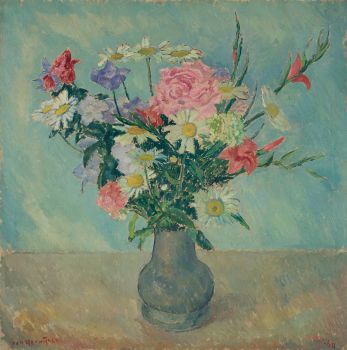
1 artwork for sale by Vilmos Huszár

Related artworks for sale




Unknown artist
Chinese gilt bronze censer, Xuande mark, 18th century, Qing dynasty18th century
Price on requestMenken Works of Art