About the artist
Gerrit Thomas Rietveld was born on 24 June 1888 in Utrecht, the Netherlands, the son of a cabinetmaker. From an early age, he became familiar with wood and craftsmanship: his father taught him the tricks of the trade, and at the age of eleven he started working in his father's workshop. Although he initially had no formal training in architecture, his career would take a crucial turn due to his boundless curiosity and his ability to challenge conventions.
In the evenings, Rietveld studied drawing and modelling at the School of Applied Arts in Utrecht. He became fascinated by new trends in art and architecture, and found inspiration in innovators such as Berlage. His drive for innovation led him to open his own furniture workshop in 1917, where he experimented with sleek, geometric shapes and the abandonment of traditional grace.
His breakthrough came with the Red and Blue Chair, which he designed in 1918. This revolutionary chair, constructed from simple slats and panels, broke radically with the heaviness and massiveness of traditional furniture. The chair became not only a design icon, but also a symbol of a new way of thinking: functionality, openness and an interplay of lines and surfaces instead of ornament and mass.
Shortly afterwards, Rietveld joined De Stijl, the avant-garde movement led by Theo van Doesburg and Piet Mondriaan. Within De Stijl, they strove for a universal visual language that radiated order and harmony, constructed from horizontal and vertical lines and primary colours, black, white and grey. Rietveld translated these principles not only into furniture, but also into architecture.
His most famous architectural work is without a doubt the Rietveld Schröder House (1924), which he designed for Truus Schröder-Schräder in Utrecht. This house, now a UNESCO World Heritage Site, is considered the only building that was built entirely according to the ideals of De Stijl. The house is characterized by sliding panels, an open floor plan, and a dynamic play of lines and color planes. Inside and outside form a continuous space: walls almost seem to dissolve into a composition of planes and lines.
After the years of De Stijl, Rietveld developed his own path. He remained true to the pursuit of simplicity and honest use of materials, but his designs became less strictly geometric. In the thirties and forties he designed modular furniture and prefabricated homes, often with the aim of making affordable and functional living possible for broad sections of the population.
After the Second World War, Rietveld was increasingly in demand as an architect. He designed, among other things, the Dutch pavilion for the Venice Biennale (1953-1954), a student flat in Utrecht (1959), and the building of the Gerrit Rietveld Academy in Amsterdam (1963-1966), which was completed after his death. His later work showed his continuous search for social meaning in architecture: a desire to contribute to a better society with his designs.
Gerrit Rietveld died on 25 June 1964 in Utrecht, one day after his 76th birthday. His legacy lives on in countless furniture classics, buildings and in the philosophy of simplicity and functionality that continues to inspire designers worldwide.
Rietveld is remembered as a pioneer who achieved maximum expressiveness with minimal means. His work embodies the idea that beauty and utility can go hand in hand — and that design can change the world.
Artworks
Filter Artworks
1 artwork for sale by Gerrit Thomas Rietveld

Related artworks for sale






Unknown artist
A pair of Dutch Colonial Solid Satinwood Chairs, Ceylon 18th century1725 - 1750
Price on requestMenken Works of Art


Arne Jacobsen
A vintage ‘Swan’ sofa, model 3321 – Fritz Hansen, Denmark1970 - 1979
Price on requestVan Kerkhoff Art


Unknown artist
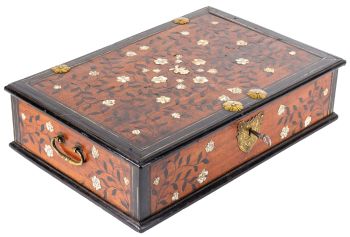
Indian colonial inlaid work box, 18th century1700 - 1750
Price on requestVerkoulen Oriental & European Antiques



Børge Mogensen
Teak wood “dropleaf” desk – Søborg Møbler, Denmark circa 19551950 - 1960
Price on requestVan Kerkhoff Art