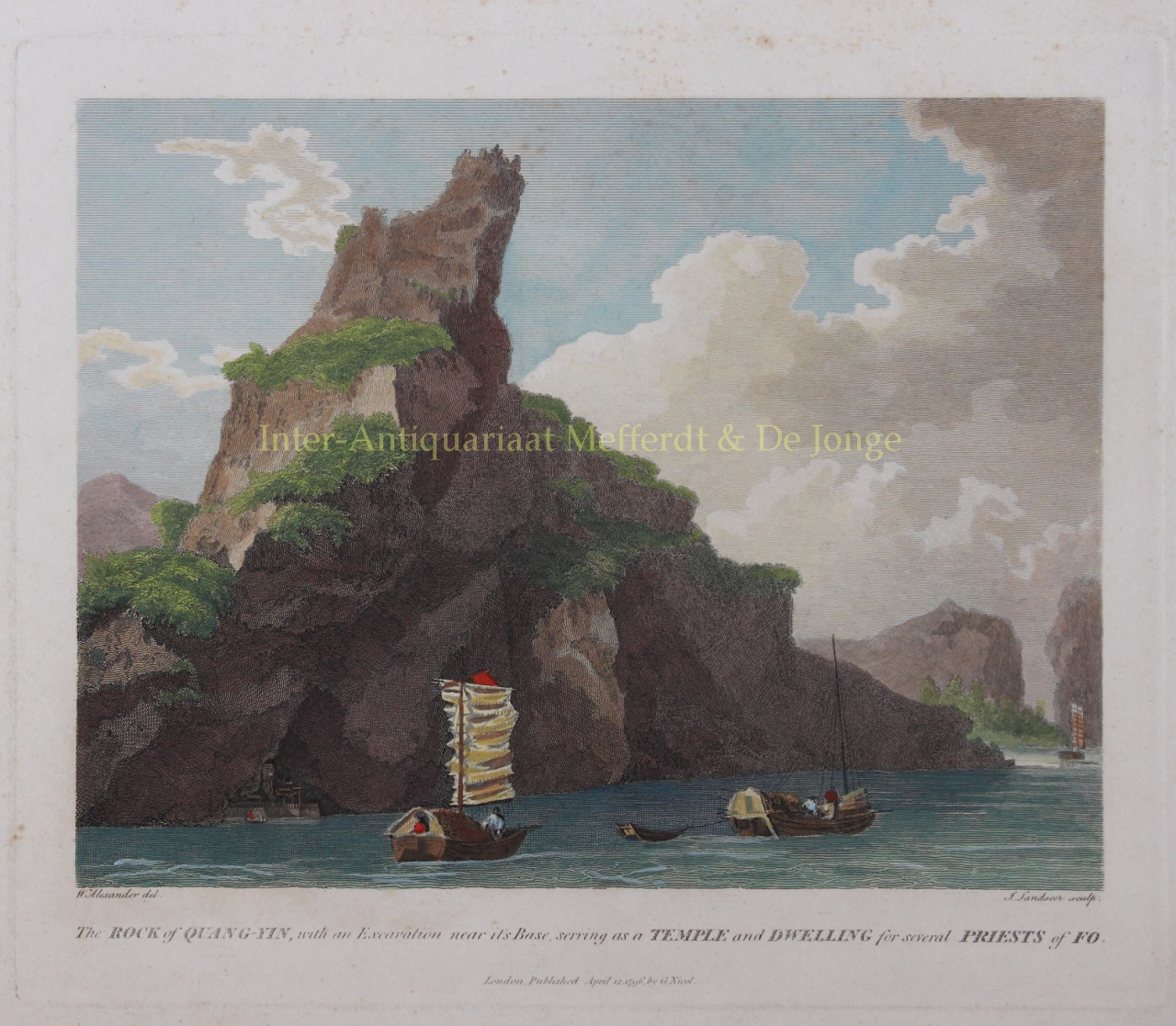
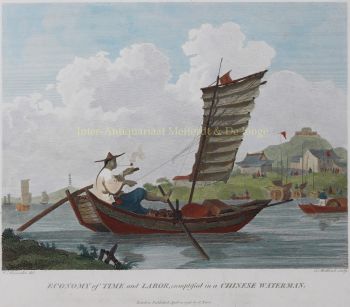
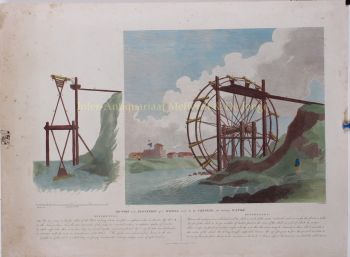
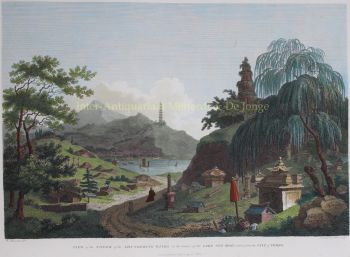
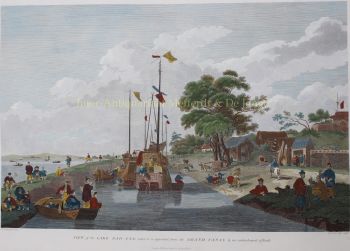
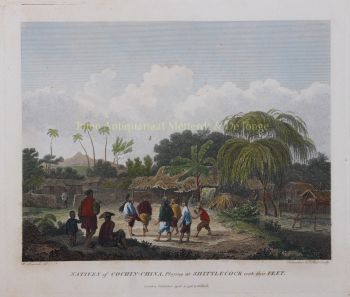
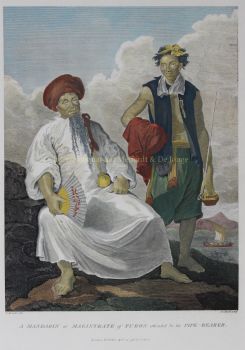
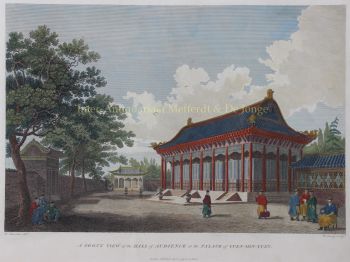
The Rock of Quang-Yin, with an Excavation near its Base, serving as a Temple and Dwelling for several, priests of Fo.” Copper engraving by John Landseer after a drawing by William Alexander (1767-1816 ) from the “Authentic account of an embassy from the King of Great Britain to the Emperor of China; including cursory observations made, and information obtained, in travelling through that ancient empire” written by Sir George Leonard Staunton and published April 12, 1796 in London by G. Nicol. Coloured by a later hand. Size (image): 17,3 x 22,4 cm. The embassy was headed by Earl George Macartney (1737-1806), who was dispatched to Beijing in 1792. He was accompanied by Staunton a medical doctor as his secretary, and a retinue of suitably impressive size, including Staunton’s 11-year-old son who was nominally the ambassador’s page. On the embassy’s arrival in China it emerged that the 11-year-old was the only European member of the embassy able to speak Mandarin, and thus the only one able to converse with the Emperor. Lord Macartney's embassy was unsuccessful, the Chinese resisting British overtures to establish diplomatic relations in view of opening the vast Chinese realms to free trade, but it opened the way for future British missions, which would eventually lead to the first Opium War and the cession of Hong Kong to Britain in 1842. It also resulted in this invaluable account, prepared at government expense, largely from Lord Macartney's notes, by Staunton, of Chinese manners, customs and artifacts at the height of the Qing dynasty. The engravings are of special interest because of their depiction of subjects that very few Europeans had heard of or seen, showing how advanced Chinese civilisation was on a technical, artistic and organizational level. Staunton describes the stupendous Rock of Quang-Yin as follows: On one side of the river was an immense rock of grey coarse marble, estimated to be about six hundred feet in height. In a large rent or fissure close to the water's edge, and accessible only by boats, is a [Buddhist] temple, inhabited by Ho-shaung, or priests of Fo, who worship there a variety of chiefs or heroes deified, and of virtues and passions personified. This temple consisted of several apartments, one over the other, of considerable height, consisting chiefly of excavations made into the rock. Above them, in a large natural fissure, was an immense mass of stalactites not less, apparently, than a ton in weight, out of which proceeded a vast number of ramifications." Price: Euro 195,-




![“Tentation” [temptation], lithograph by Eugène Grasset](https://media-3.gallerease.com/images/b891f1b8-508a-4829-a559-a56b7f765ca7/350x350/tentation-temptation-lithograph.jpg)


![RARE ARMORIAL MAP: LEO BRABANTIAE Lion of the most noble Duchy of Brabant] by Sibertus Waterloos](https://media-3.gallerease.com/images/325cc033-a3b6-495f-9da8-6d06caf29b14/350x350/rare-armorial-map-leo-brabantiae-lion-of-the-most-noble-duchy-of-brabant.jpg)