17TH-CENTURY UTRECHT 1652
Joan Blaeu
Carta
38 ⨯ 50 cm
€ 1.650
Inter-Antiquariaat Mefferdt & De Jonge
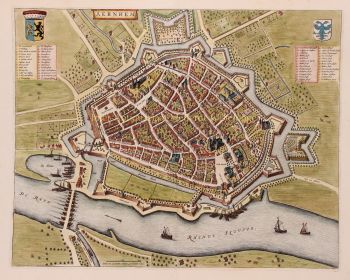
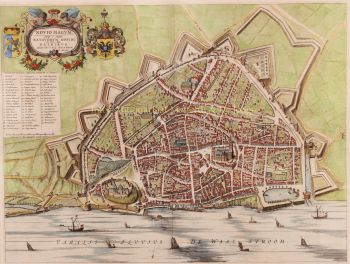
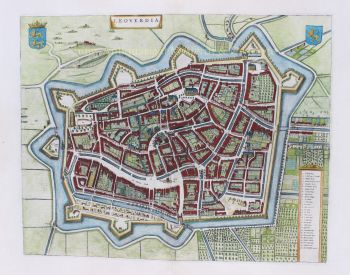
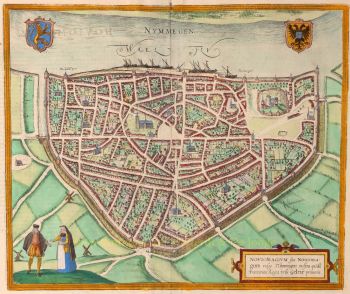
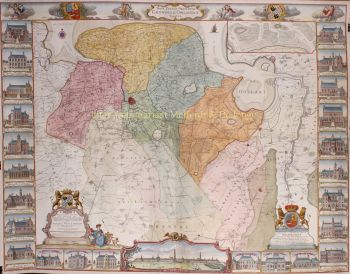
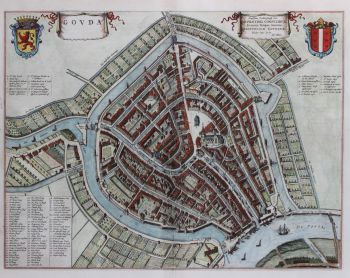
- A proposito di opere d'arte17TH-CENTURY UTRECHT “Traiectum Wttrecht,” copper engraving published by Joan Blaeu, ca. 1649 in his famous town book of the Netherlands: "Het Toneel der Steden van de Vereenigde Nederlanden met hare Beschrijvingen" [The Theatre of the Cities of the United Netherlands with their Descriptions]. Coloured by a later hand. Size approx. 38 × 50 cm. The copperplate from which the print was made must have been engraved between 1642 and 1649, since the Smeetoren, which was converted into an astronomical observatory in 1642, is indicated in the legend (no. 56) as “observatorium.” The map reflects the situation of 1642–1644, as the Pieterstraat—laid out in 1644—does not yet appear. The map contains several inaccuracies: the Salvatorkerk, already demolished in 1587, is still depicted; the Catharijne Gate is shown in its pre-1625 form; and the Vaartse Rijn and Oude Rijn are incorrectly oriented. After the founding of the university in 1636, the city created a sports field outside the city moat for the students, where the then-popular game of jeu de mail could be played (legend no. 53: Palle maille baen). With its six pall-mall players and rows of trees, the map provides a clear impression of this 17th-century recreation ground. The Amsterdam cartographer and publisher Joan Blaeu sought to fulfill the ambitions of earlier mapmakers Abraham Ortelius and Georg Braun & Frans Hogenberg by adding a series of city books to his multi-volume world atlas. Blaeu’s Toneel der Steden van de Vereenighde Nederlanden appeared in a Latin edition in 1649; the Dutch edition was printed in 1652. Some of the maps included in the work had already been published in earlier atlases—21, for instance, in Marcus Boxhorn’s Theatrum Hollandiae of 1632—while others were newly engraved specifically for Blaeu’s town book. It is known that Blaeu sent letters to city councils requesting that they provide him with a city plan and a written description to include in his work. Literature: “Kaarten van Utrecht” – Donkersloot de Vrij (1989), no. 14 Prijs Euro 1.650,-
- A proposito di opere artista
Joan Blaeu (1596-1673), nacque il 23 settembre 1596 ad Alkmaar.
Era un cartografo olandese nato ad Alkmaar. Ha seguito le orme di suo padre, il cartografo Willem Blaeu.
Nel 1620 divenne dottore in legge ma si unì al lavoro del padre. Nel 1635 pubblicarono l'Atlas Novus (titolo completo: Theatrum orbis terrarum, sive, Atlas novus) in due volumi. Joan e suo fratello Cornelius rilevarono lo studio dopo la morte del padre nel 1638. Joan divenne il cartografo ufficiale della Compagnia Olandese delle Indie Orientali.
La mappa del mondo di Blaeu, Nova et Accuratissima Terrarum Orbis Tabula, che incorpora le scoperte di Abel Tasman, fu pubblicata nel 1648. Questa mappa era rivoluzionaria in quanto "raffigura il sistema solare secondo le teorie eliocentriche di Niccolò Copernico, che mostrano la terra che ruota attorno il sole... Sebbene l'innovativo libro di Copernico Sulle rivoluzioni delle sfere fosse stato stampato per la prima volta nel 1543, poco più di un secolo prima, Blaeu fu il primo cartografo a incorporare questa rivoluzionaria teoria eliocentrica in una mappa del mondo."
La mappa di Blaeu è stata copiata per la mappa del mondo ambientata nel pavimento del Groote Burger-Zaal del nuovo municipio di Amsterdam, progettato dall'architetto olandese Jacob van Campen (ora il Palazzo Reale di Amsterdam), nel 1655.
L'Hollandia Nova di Blaeu fu raffigurata anche nel suo Archipelagus Orientalis sive Asiaticus pubblicato nel 1659 nel Kurfürsten Atlas (Atlante del Grande Elettore). e utilizzato da Melchisédech Thévenot per produrre la sua mappa, Hollandia Nova-Terre Australe (1664).
Come "Jean Blaeu", ha anche pubblicato il volume 12 "Le Grand Atlas, ou Cosmographie blaviane, en laquelle est exactement descritto la terre, la mer, et le ciel". Un'edizione è datata 1663. Era in folio (540 x 340 mm) e conteneva 593 mappe e tavole incise. Nel marzo 2015, una copia era in vendita per £ 750.000.
Intorno al 1649 Joan Blaeu pubblicò una raccolta di mappe cittadine olandesi chiamata Toonneel der Steeden (Vedute di città). Nel 1651 fu votato nel consiglio di Amsterdam. Nel 1654 Joan pubblicò il primo atlante della Scozia, ideato da Timothy Pont. Nel 1662 ristampò l'Atlas Novus, noto anche come Atlas Maior, in 11 volumi e uno per gli oceani.
Una cosmologia era prevista come progetto successivo, ma un incendio distrusse completamente lo studio nel 1672.
Joan Blaeu morì ad Amsterdam l'anno successivo, 1673. Fu sepolto nella Westerkerk ad Amsterdam.

Sei interessato ad acquistare questa opera d'arte?
Artwork details
Related artworks
- 1 - 4 / 12
Artista Sconosciuto
Een Gotische zuidelijke Nederlanden wandklok1580 - 1590
Prezzo su richiestaNico van den Assem restauratie
Gobert Denis Chambon/ Jean Janvier, S.G. Longschamps
Magnificient antiek World map1754
€ 17.500Inter-Antiquariaat Mefferdt & De Jonge
A cura diDanny Bree
1 - 4 / 24- 1 - 4 / 24
Jean-François Rauzier
Oasis Hotel - Limited edition of 8 2017
Prezzo su richiestaVilla del Arte Galleries
1 - 4 / 24Rene Rietmeyer
"PORTRAIT OF TOMOJI OGAWA SEPTEMBER 1999"1999
Prezzo su richiestaEuropean Cultural Centre Collection
Jan Toorop
Farmers with cattle on their way to Domburg1914
Prezzo su richiestaGalerie Het Noorderlicht
Jan Toorop
Narcissus Poeticus met kinderen van Van Schendel uit Ede1919
Prezzo su richiestaStudio 2000 Art Gallery
1 - 4 / 24- 1 - 4 / 12


![“Tentation” [temptation], lithograph by Eugène Grasset](https://media-3.gallerease.com/images/b891f1b8-508a-4829-a559-a56b7f765ca7/350x350/tentation-temptation-lithograph.jpg)