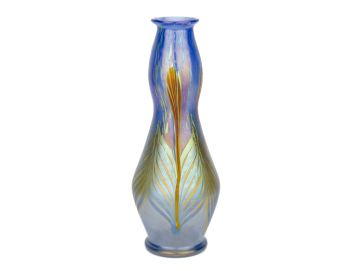
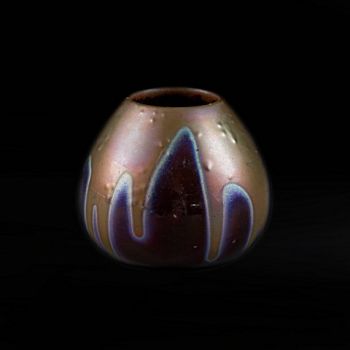
Johann Loetz Witwe – Phänomen Genre 8065 – Thea 1899 - 1900
Johann Loetz (Lötz) Witwe Klostermühle
Verre
18 ⨯ 4 cm, ø 5 cm
ConditionExcellent
Prix sur demande
Antiques Emporium
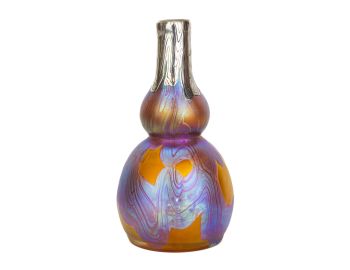
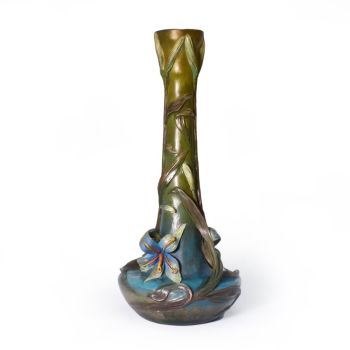
- Sur l'oeuvre d'artThis elegant Phänomen Genre 8065 Art Nouveau vase, crafted by Johann Loetz Witwe, was designed in 1899, just before the great success of the Paris Exposition Universelle in 1900. During this crucial period, Max Ritter von Spaun and Eduard Prochaska were fully engaged in refining innovative glass techniques and developing groundbreaking designs. Their goal was to elevate the iridescent glass, which they had been producing since 1898, to an even higher level and to firmly establish Loetz as a pioneer in the world of glass art.
This vase is a stunning example of the artistic and technical innovations that Johann Loetz Witwe introduced around 1899. The combination of the subtle color, the intricate glass thread decoration, and the refined iridescence makes this piece an exceptionally rare and highly sought-after object in the world of Art Nouveau glass art.
Johann Loetz Witwe – Phänomen Genre 8065 – Thea
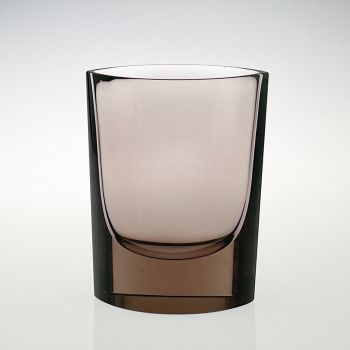
This vase is blown in the subtle and refined base color “Thea,” a soft hue that beautifully enhances the iridescence and decoration. The execution belongs to the rare Phänomen Genre 8065, which debuted in 1899. Remarkably, this is one of the few Phänomen Genre decorations produced under the same production number, 8065, further emphasizing the exclusivity of this decor.
The surface of the vase is adorned with a dense pattern of silver-blue glass threads that gracefully swirl across the body. The upper section is further enriched with applied silver-blue bands, which are pulled downward into elegant, elongated droplet shapes. This delicate and highly refined decoration creates a dynamic and flowing effect, characteristic of the innovative aesthetics of Loetz glass art at the turn of the century.
The combination of the subtle base color “Thea,” the intricate glass thread decoration, and the refined iridescence makes this piece an exceptionally rare and highly sought-after object in the world of Art Nouveau glass art. The decorative technique, where silver-yellow glass threads elegantly weave across the surface and extend into elongated droplet shapes, reflects the innovative spirit of Loetz during this period.
Signature
The vase is in excellent condition and is signed with a wheel-engraved “Loetz Austria” mark. This signature was first introduced just before the turn of the century, during a period when Loetz began systematically marking their works for the international market. As Loetz gained increasing global recognition, a more distinctive signature became necessary, since the earlier marking with Max Ritter von Spaun’s family crest was not directly associated with the glassworks.
Additionally, the original spelling “Lötz” with an umlaut proved confusing for languages that do not use this diacritical mark. To avoid misunderstandings and enhance brand recognition, the standardized signature “Loetz Austria” was introduced, specifically intended for export markets. - Sur l'artiste
La verrerie Loetz a existé à Klostermuhle, en Autriche, pendant un peu plus de cent ans, à partir de 1840. Mais son apogée a eu lieu du vivant de Max Ritter Von Spaun, petit-fils du premier Johann Loetz qui avait fondé l'entreprise.
Von Spaun a repris l'entreprise en 1879 et l'a dirigée jusqu'en 1908, un an avant sa mort. Il est assisté d'Eduard Prochaska, son spécialiste technique, et ensemble ils inventent, conçoivent et produisent toute une série de merveilleux nouveaux types de verre, en déposant plusieurs brevets et en remportant des prix dans toutes les grandes expositions mondiales des années 1890 et des premières années de le nouveau siècle.
La société Loetz figurait parmi les leaders du design Art Nouveau et en particulier du verre d'art irisé. Le verre "Papillon", comme le vase de gauche, est parfois appelé aujourd'hui verre "à tache d'huile". Une autre coloration préférée de Loetz était le verre irisé avec des traînées tirées appelé verre « Phenomenon ».
Il y avait des vases irisés avec des rubans de couleurs métalliques enroulés sur la surface, et de nombreux motifs spectaculaires avec des traînées appliquées de belles couleurs, ou simplement retirés du corps du verre pour former des poignées ou une décoration.
Vers 1900, la société a commencé à collaborer avec des designers extérieurs et de grands artistes ont conçu des pièces pour Lotz, notamment Joseph Hofmann, Koloman Moser, Maria Kirchner et Hofstatter.
En 1908, Loetz a été repris par le fils de Max Von Spaun, également appelé Max, et bien qu'il ait connu des difficultés financières (faillite en 1911 et à nouveau en 1931), il y avait plusieurs grands designers dont le travail a été produit par Loetz au cours de ces années et à travers l'art période déco. Ceux-ci comprenaient Adolf Beckert et Michael Powolny.
Êtes-vous intéressé par l'achat de cette oeuvre?
Artwork details
Related artworks
Johann Loetz (Lötz) Witwe Klostermühle
Johann Loetz Witwe - Phänomen Genre 7773 – Orange1900 - 1910
Prix sur demandeAntiques Emporium
Johann Loetz (Lötz) Witwe Klostermühle
Johann Loetz Witwe – Phänomen Genre 1/18 vase1901 - 1905
Prix sur demandeAntiques Emporium
1 - 4 / 8Daum Nancy
Daum Nancy – Tall Bryones / Bryonia dioica vase with applied berries1902 - 1907
Prix sur demandeAntiques Emporium
Artiste Inconnu
François-Théodore Legras – Tall “Fleurs de Pommier” apple blossoms vase1900 - 1909
Prix sur demandeAntiques Emporium
René Lalique
Un ancien vase 'Bluets' conçu par René Lalique (1860-1945)1910 - 1920
Prix sur demandeLennart Booij Fine Art and Rare Items
1 - 4 / 24Artiste Inconnu
François-Théodore Legras – Tall “Fleurs de Pommier” apple blossoms vase1900 - 1909
Prix sur demandeAntiques Emporium
Johann Loetz (Lötz) Witwe Klostermühle
Johann Loetz Witwe – Phänomen Genre 1/18 vase1901 - 1905
Prix sur demandeAntiques Emporium
1 - 4 / 24Daum Nancy
Daum Nancy – Tall Bryones / Bryonia dioica vase with applied berries1902 - 1907
Prix sur demandeAntiques Emporium
Johann Loetz (Lötz) Witwe Klostermühle
Johann Loetz Witwe – Phänomen Genre 1/18 vase1901 - 1905
Prix sur demandeAntiques Emporium
1 - 4 / 24René Lalique
Un ancien vase 'Bluets' conçu par René Lalique (1860-1945)1910 - 1920
Prix sur demandeLennart Booij Fine Art and Rare Items
Victor Spinelli
Diver Up - Pure White (Edition of 12)2020 - 2026
Prix sur demandeVilla del Arte Galleries
1 - 4 / 24Artiste Inconnu
François-Théodore Legras – Tall “Fleurs de Pommier” apple blossoms vase1900 - 1909
Prix sur demandeAntiques Emporium
Daum Nancy
Daum Nancy – Tall Bryones / Bryonia dioica vase with applied berries1902 - 1907
Prix sur demandeAntiques Emporium
Johann Loetz (Lötz) Witwe Klostermühle
Johann Loetz Witwe - Phänomen Genre 7773 – Orange1900 - 1910
Prix sur demandeAntiques Emporium
1 - 4 / 12