Johann Loetz Witwe – Phänomen Genre 1/18 vase 1901 - 1905
Johann Loetz (Lötz) Witwe Klostermühle
Copo
25 cm, ø 13 cm
ConditionExcellent
Preço em pedido
Antiques Emporium
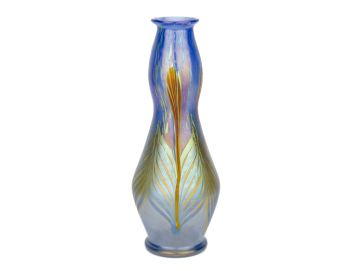
- Sobre arteThis impressive Jugendstil vase was created by the renowned glassworks Johann Loetz Witwe, located in Klostermühle (present-day Czech Republic). Around 1900, Loetz gained international acclaim for its innovative and artistically sophisticated iridescent glass objects, many of which were presented at world exhibitions such as the Exposition Universelle in Paris in 1900. The company was led by Max Ritter von Spaun, with Eduard Prochaska as technical director, and became known for its groundbreaking techniques, forms, and decorative designs.
Phänomen Genre 1/18
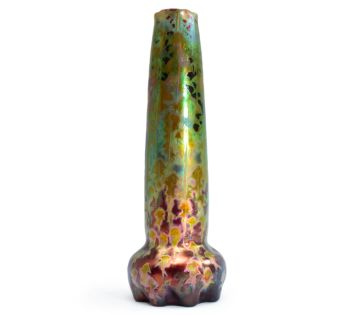
The vase shown here is executed in Phänomen Genre 1/18, a decor introduced in 1901. This particular genre is easily recognizable by its distinct base color “Zephir”—a transparent, light green to greyish-turquoise tone that gives the piece a modern appearance. Over this base, deep blue vertically applied “tadpoles” are meticulously placed—stylized droplet-shaped elements with silvery iridescent stripes that reflect light in a captivating manner. This interplay of color and texture gives the vase a dynamic and strikingly contemporary character, remarkably ahead of its time.
The form of the vase resembles a gourd or bottle shape, with the body transitioning smoothly into a slender neck and slightly flared mouth. The rim is clearly flame-finished, where the tips of the tadpoles are subtly fused into the edge—an expression of the high level of craftsmanship involved in the making of this piece. With its height of 25 cm, the vase provides an ideal canvas for the Phänomen Genre 1/18 décor; the elongated shape elegantly accentuates the vertical alignment of the tadpoles.
Signature
The underside of the vase features a perfectly polished pontil, a detail that is characteristic of high-quality Loetz productions from this period. Although this particular example is unsigned, the combination of décor, form, and execution unmistakably confirms its authenticity as a true Loetz creation.
Afmetingen:
Height: 25cm / 9.84”
Diameter top: 5,5cm / 2.17”
Diameter base: 10,5cm / 4.13“
Condition: Mint
Literature:
Prestel – Böhmisch Glas 1880 – 1940 Band 1 Werkmonographie – Page 333.
Hatje Cantz – Loetz Bohemian Glass 1880 – 1940 – Page 113 & 303 - Sobre artista
A vidraria Loetz existiu em Klostermuhle, Áustria, por pouco mais de cem anos, começando em 1840. Mas seu apogeu foi durante a vida de Max Ritter Von Spaun, neto do original Johann Loetz que fundou a empresa.
Von Spaun assumiu a empresa em 1879 e a dirigiu até 1908, um ano antes de sua morte. Ele foi auxiliado por Eduard Prochaska, seu especialista técnico, e juntos eles inventaram, projetaram e produziram uma série de novos e maravilhosos tipos de vidro, tirando várias patentes e ganhando prêmios em todas as maiores exposições mundiais durante a década de 1890 e os primeiros anos de o novo século.
A empresa Loetz estava entre os líderes em design Art Nouveau e especialmente em vidro de arte irridescente. O vidro "Papillon", como o vaso à esquerda, é às vezes conhecido hoje como vidro "manchado de óleo". Outro colorante favorito de Loetz era o vidro irradiado com trilhas puxadas, chamado de vidro "Fenômeno".
Havia vasos irritados com fitas de cores metálicas enroladas na superfície, e muitos desenhos espetaculares com rastros aplicados de belas cores, ou simplesmente puxados para fora do corpo do vidro para formar alças ou decoração.
Por volta de 1900, a empresa começou a colaborar com designers externos, e alguns grandes artistas criaram peças para Lotz, notavelmente Joseph Hofmann, Koloman Moser, Maria Kirchner e Hofstatter.
Em 1908, Loetz foi adquirido pelo filho de Max Von Spaun, também chamado de Max, e embora tivesse dificuldades financeiras (indo à falência em 1911 e novamente em 1931), havia vários grandes designers cujo trabalho foi produzido por Loetz durante aqueles anos e através da arte período deco. Entre eles, Adolf Beckert e Michael Powolny.
Você está interessado em comprar esta obra de arte?
Artwork details
Related artworks
Johann Loetz (Lötz) Witwe Klostermühle
Johann Loetz Witwe – Phänomen Genre 8065 – Thea1899 - 1900
Preço em pedidoAntiques Emporium
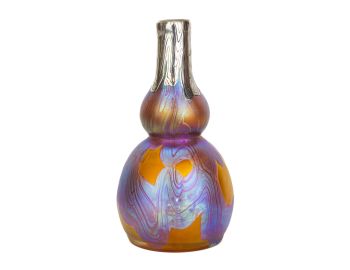
Johann Loetz (Lötz) Witwe Klostermühle
Johann Loetz Witwe - Phänomen Genre 7773 – Orange1900 - 1910
Preço em pedidoAntiques Emporium
1 - 4 / 8- 1 - 4 / 24
Johann Loetz (Lötz) Witwe Klostermühle
Johann Loetz Witwe – Phänomen Genre 8065 – Thea1899 - 1900
Preço em pedidoAntiques Emporium
Daum Nancy
Daum Nancy – Tall Bryones / Bryonia dioica vase with applied berries1902 - 1907
Preço em pedidoAntiques Emporium
Johann Loetz (Lötz) Witwe Klostermühle
Johann Loetz Witwe - Phänomen Genre 7773 – Orange1900 - 1910
Preço em pedidoAntiques Emporium
1 - 4 / 24Johann Loetz (Lötz) Witwe Klostermühle
Johann Loetz Witwe - Phänomen Genre 7773 – Orange1900 - 1910
Preço em pedidoAntiques Emporium
Johann Loetz (Lötz) Witwe Klostermühle
Johann Loetz Witwe – Phänomen Genre 8065 – Thea1899 - 1900
Preço em pedidoAntiques Emporium
1 - 4 / 24- 1 - 4 / 24
Johann Loetz (Lötz) Witwe Klostermühle
Johann Loetz Witwe - Phänomen Genre 7773 – Orange1900 - 1910
Preço em pedidoAntiques Emporium
Johann Loetz (Lötz) Witwe Klostermühle
Johann Loetz Witwe – Phänomen Genre 8065 – Thea1899 - 1900
Preço em pedidoAntiques Emporium
1 - 4 / 12