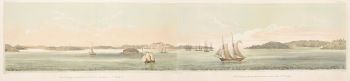
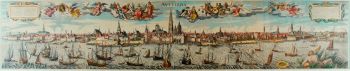
Dutch Loango-Angola - Salomon Saverij after Frans Post, 1647 1647
Artista Desconhecido
Imprimir
38 ⨯ 100 cm
€ 1.250
Inter-Antiquariaat Mefferdt & De Jonge
- Sobre arteLUANDA ON THE DUTCH LOANGO-ANGOLA COAST “Loanda S. Pauli” (São Paulo de Luanda), etching and engraving printed from two plates made by Salomon Saverij, after a drawing by Frans Post of 1645, from Caspar Barlaeus’, “Rerum per octennium in Brasilia et alibi nuper gestarum sub praefectura J. Mauritii, Nassoviae, c. comitis... historia” piblished by Joan Blaeu in 1647. Size: approx. 38 x 100 cm. View of Luanda in Angola with several Dutch ships off the coast. The fort was part of the Dutch Loango-Angola coast. In the seventeenth century, the city of Luanda was the largest Portuguese slave depot in West Africa. Therefore, on behalf of the Dutch West India Company (WIC), admiral Piet Hein attempted to conquer the city, defended by a fort, as early as 1624. However, due to a lack of troops and ships, this attack failed. In 1641, a second and successful attempt followed under the leadership of Cornelis Jol, a.k.a. "Houtebeen" (pegleg), after which the city and the fort (renamed Fort Aardenburgh) came under the control of the WIC. Due to its southern location, the city was not governed from Elmina (in present-day Ghana), and a new government was established under the name Luango-Angola, with the governor's seat in Luanda. However, in the period until 1648, 'only' 14,000 slaves were transported from the city, and the Dutch colony was not profitable. When the city was recaptured by Portugal in 1648, it was decided not to sail to places south of Congo. The Portuguese were considerably more 'successful' in the slave trade. From around 1550 to 1850, over 2.8 million slaves were shipped from Luanda. This print was part of a series depicting the journey to and stay in Brazil of Governor-General John Maurice of Naussau in the years 1636-1644. The drawings were made by Frans Post, who was the first European to capture the New World. We now see that journey to Brazil passed through Luanda, which was under the control of the WIC for about 8 years. Price: 1.250,-
- Sobre artista
Pode acontecer que um artista ou criador seja desconhecido.
Algumas obras não devem ser determinadas por quem são feitas ou são feitas por (um grupo de) artesãos. Exemplos são estátuas dos tempos antigos, móveis, espelhos ou assinaturas que não são claras ou legíveis, mas também algumas obras não são assinadas.
Além disso, você pode encontrar a seguinte descrição:
•"Atribuído a …." Na opinião deles, provavelmente uma obra do artista, pelo menos em parte
• “Estúdio de…” ou “Oficina de” Em sua opinião um trabalho executado no estúdio ou oficina do artista, possivelmente sob sua supervisão
• "Círculo de ..." Na opinião deles, uma obra da época do artista mostrando sua influência, intimamente associada ao artista, mas não necessariamente seu aluno
•“Estilo de…” ou “Seguidor de…” Na opinião deles, um trabalho executado no estilo do artista, mas não necessariamente por um aluno; pode ser contemporâneo ou quase contemporâneo
• "Maneira de ..." Na opinião deles, uma obra no estilo do artista, mas de data posterior
•"Depois …." Na opinião deles uma cópia (de qualquer data) de uma obra do artista
• “Assinado…”, “Datado…” ou “Inscrito” Na opinião deles, a obra foi assinada/datada/inscrita pelo artista. A adição de um ponto de interrogação indica um elemento de dúvida
• "Com assinatura ….”, “Com data ….”, “Com inscrição ….” ou “Tem assinatura/data/inscrição” na opinião deles a assinatura/data/inscrição foi adicionada por outra pessoa que não o artista

Você está interessado em comprar esta obra de arte?
Artwork details
Related artworks
- 1 - 4 / 12
- 1 - 4 / 24
Cornelis Anthonisz Theunissen
MUITO RARO PRIMEIRO MAPA IMPRESSO DE AMESTERDÃO, UMA CIDADE EM ASCENSÃO1544
€ 125.000Inter-Antiquariaat Mefferdt & De Jonge
Com curadoria deDanny Bree
1 - 4 / 24- 1 - 4 / 24
- 1 - 4 / 12