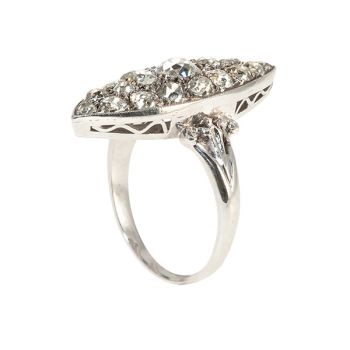
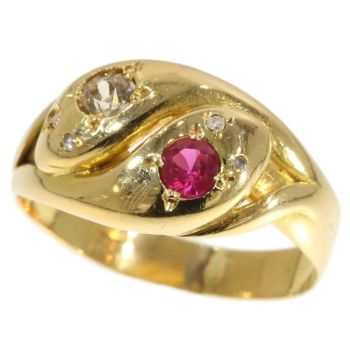
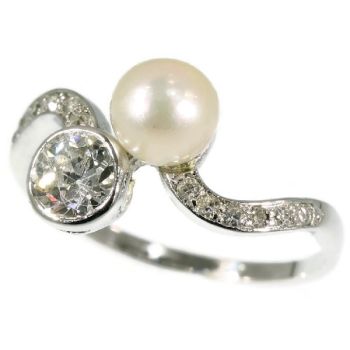
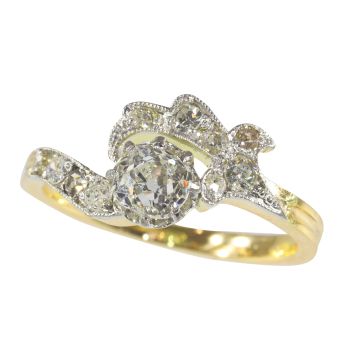
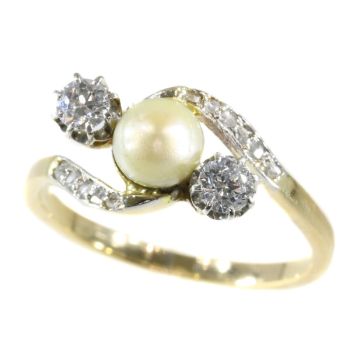
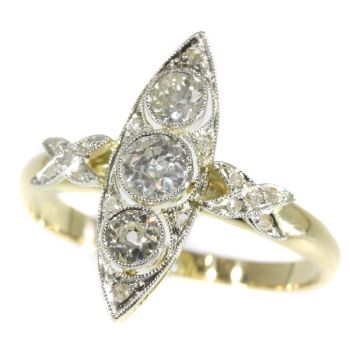
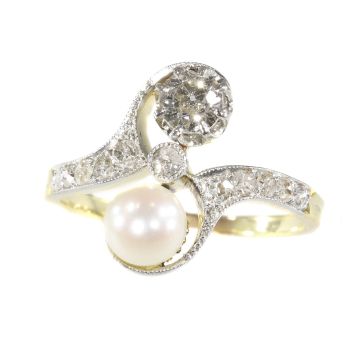
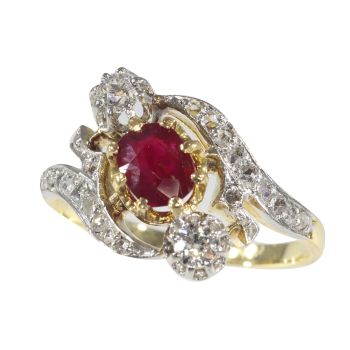
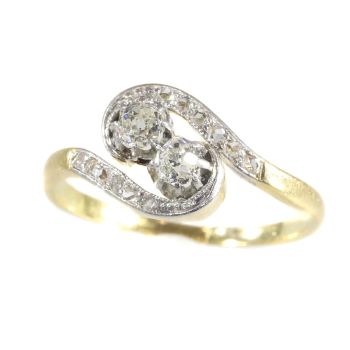
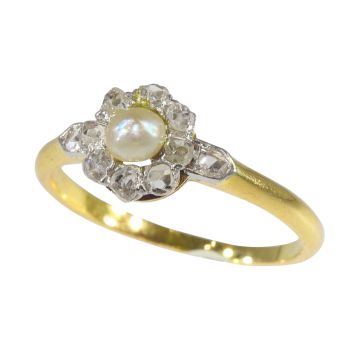
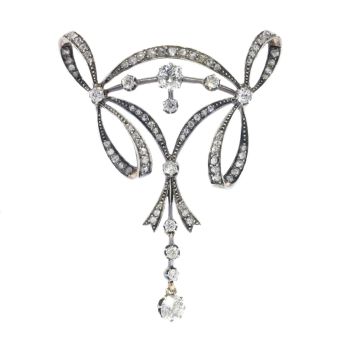
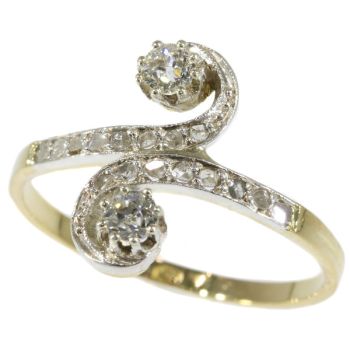
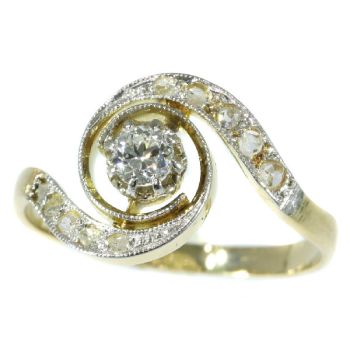
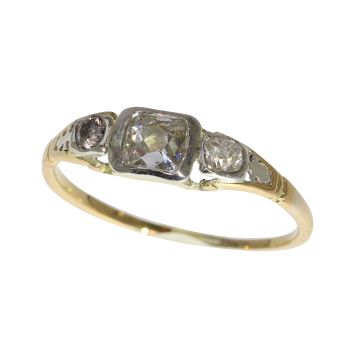
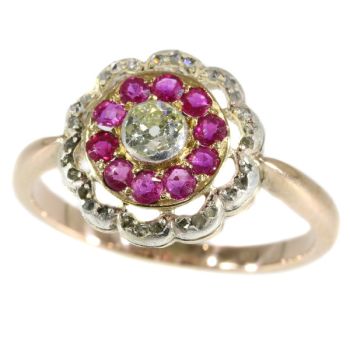
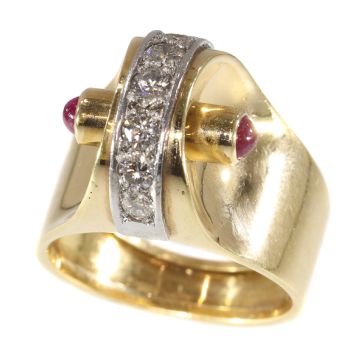
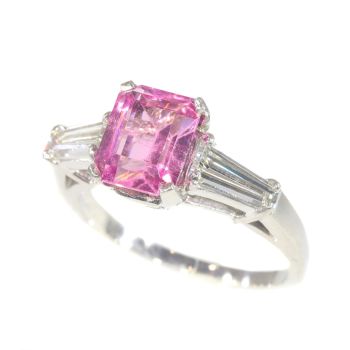
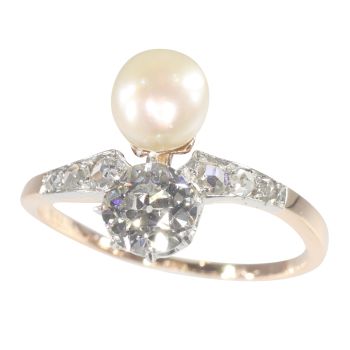
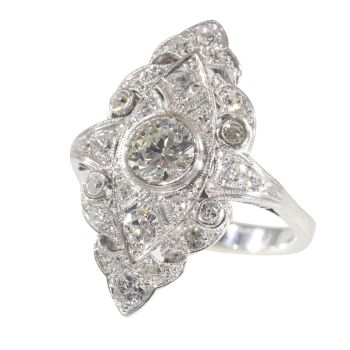
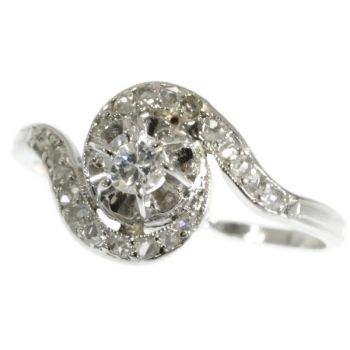
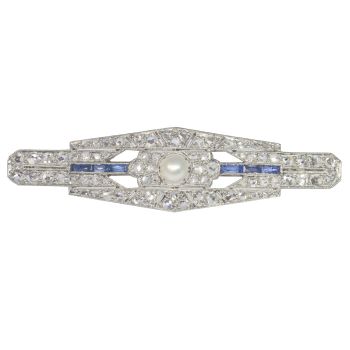
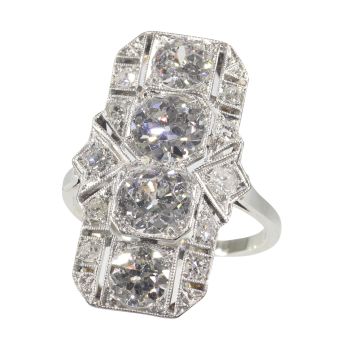
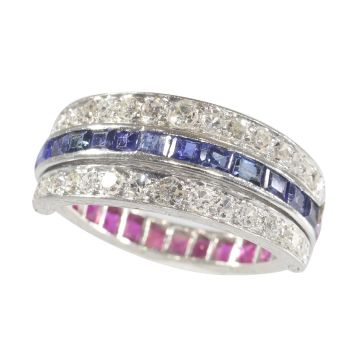
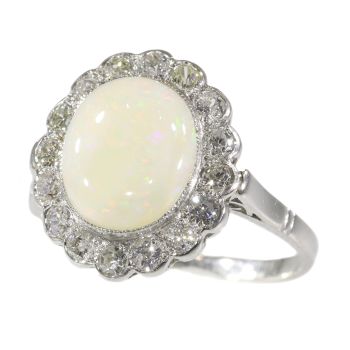
Circa 1900, a Belle Epoque diamond ring in 18 carat white gold, centred on one old European cut diamond between two old brilliant cut diamonds, each in a smooth bezel. The open scroll shoulders, set with rose cut diamonds and fine millegrain, give thatunmistakable Belle Epoque airiness: elegant, restrained, and quietly romantic. It catches the light with a softer shimmer rather than a shout, and feels like a jewel made to be worn and kept. Total weight of the three principal diamonds approximately1.80 carats.
Jewellery Type ring
Condition very good condition more info on our condition scale
Country of origin unknown
Style something between the Late-Victorian and Belle Epoque style - Victorian decorative arts refers to the style of decorative arts during the Victorian era. The Victorian era is known for its eclectic revival and interpretation of historic styles and theintroduction of cross-cultural influences from the middle east and Asia in furniture, fittings, and Interior decoration.
Victorian design is widely viewed as having indulged in a regrettable excess of ornament. And the Belle Époque style (Belle Époque is French for "Beautiful Era") was a period in European social history that began during the late 19th century and lasted until World War I. Occurring during the time of the French Third Republicand the German Empire, the "Belle Époque" was named in retrospect, when it began to be considered a "golden age" the major powers of Europe, new technologies improved lives and the commercial arts adapted Renaissance and eighteenth-century stylesto modern forms. In the newly rich United States, emerging from the Panic of 1873, the comparable epoch was dubbed the Gilded Age. In the United Kingdom, this epoch overlaps the end of what is called the Victorian Era there and the period named theEdwardian Era. See also: late-Victorian more info on styles
Style specifics The Belle Époque (French for "Beautiful Era") was a period in European social history that began during the late 19th century from the Franco-Prussian War (1870-1871) and lasted until World War I (1914-18).
Occurring during the time of the French Third Republic and the German Empire, the "Belle Époque" was named in retrospect, when it began to be considered a "golden age" the major powers of Europe, new technologies improved lives and the commercialarts adapted Renaissance and eighteenth-century styles to modern forms.
In the newly rich United States, emerging from the Panic of 1873, the comparable epoch was dubbed the Gilded Age. In the United Kingdom, this epoch overlaps the end of what is called the Victorian Era there and the period named the Edwardian Era.
In the Belle Époque cheap coal and cheap labour contributed to the cult of the orchid and made possible the perfection of fruits grown under glass, as the apparatus of state dinners extended to the upper classes; champagne was perfected during the Belle Époque. Exotic feathers and furs were more prominently featured in fashion than ever before, as haute couture was invented in Paris, the centre of the Belle Époque, where fashion began to move in a yearly cycle; in Paris restaurantssuch as Maxim's achieved a new splendour and cachet as places for the rich to parade, and the Opéra Garnier devoted enormous spaces to staircases as similar show places.
After mid-century, railways linked all the major cities of Europe to spa towns like Biarritz and Deauville; their carriages were rigorously divided into first-class and second-class, but the super-rich now began to commission private railway coaches, asexclusivity was a hallmark of opulent luxury. Bohemian lifestyles gained a different glamour, pursued in the cabarets of Montmartre.
Period ca. 1900 Events & facts of this era, poetry of this era, fashion of this era.
Material 18K white gold (touchstone tested) more info on precious metals
Diamonds One old European cut diamond with an estimated weight of ± 0.80ct Two old brilliant cut diamondswith an estimated weight of ± 1.00ct Fourteen rose cut diamonds. We do not have the weight of the diamonds which is normal in our trade when it comes to rose cuts.
Total diamond countwithout rose cuts Three pcs.
Total diamond weightwithout rose cuts approx. 1.80 crt with an average colour and clarity H/J, vs/si
- When we provide weights, colour grades, and clarity of diamonds, these are approximate unless otherwise stated, as we do not remove diamonds from their settings to preserve the integrity of the piece.
- All diamonds, regardless of their size or shape, in our vintage and antique jewellery are verified as 100% natural by the IJGC laboratory.
- We do not sell lab-grown (synthetic) diamonds.
Birthstones Diamond is the birthstone (or month stone) for April. more info on birthstones
Hallmarks No trace. more info on hallmarks
Dimensions band width top of ring 1,81 cm (0,71 inch) see picture with a ruler in millimeters and inches
Weight 4,20 gram (2,70 dwt)
Ring size Continental EU: 54 & 17¼ , Size USA: 6¾ , Size UK: N
Resizing Free resizing (only for extreme resizing we have to charge). more info on ring sizes
Adin Reference Nº 25351-0042
Copyright photography Adin, fine antique jewellery
Additional information our latest acquisitions jewelry glossary wall of fame visit us in Antwerp subscribe to our mailinglist
Pode acontecer que um artista ou criador seja desconhecido.
Algumas obras não devem ser determinadas por quem são feitas ou são feitas por (um grupo de) artesãos. Exemplos são estátuas dos tempos antigos, móveis, espelhos ou assinaturas que não são claras ou legíveis, mas também algumas obras não são assinadas.
Além disso, você pode encontrar a seguinte descrição:
•"Atribuído a …." Na opinião deles, provavelmente uma obra do artista, pelo menos em parte
• “Estúdio de…” ou “Oficina de” Em sua opinião um trabalho executado no estúdio ou oficina do artista, possivelmente sob sua supervisão
• "Círculo de ..." Na opinião deles, uma obra da época do artista mostrando sua influência, intimamente associada ao artista, mas não necessariamente seu aluno
•“Estilo de…” ou “Seguidor de…” Na opinião deles, um trabalho executado no estilo do artista, mas não necessariamente por um aluno; pode ser contemporâneo ou quase contemporâneo
• "Maneira de ..." Na opinião deles, uma obra no estilo do artista, mas de data posterior
•"Depois …." Na opinião deles uma cópia (de qualquer data) de uma obra do artista
• “Assinado…”, “Datado…” ou “Inscrito” Na opinião deles, a obra foi assinada/datada/inscrita pelo artista. A adição de um ponto de interrogação indica um elemento de dúvida
• "Com assinatura ….”, “Com data ….”, “Com inscrição ….” ou “Tem assinatura/data/inscrição” na opinião deles a assinatura/data/inscrição foi adicionada por outra pessoa que não o artista
Você está interessado em comprar esta obra de arte?