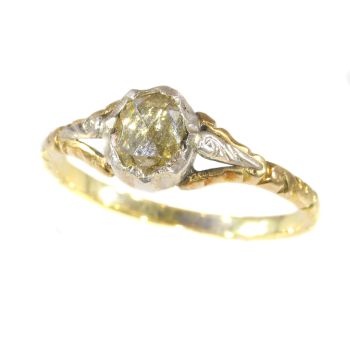
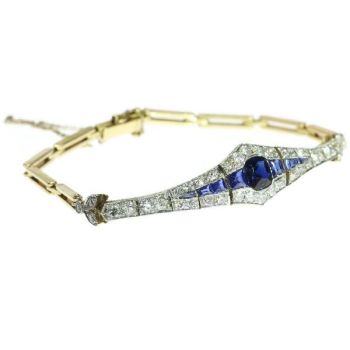
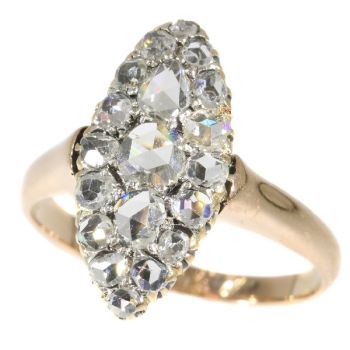
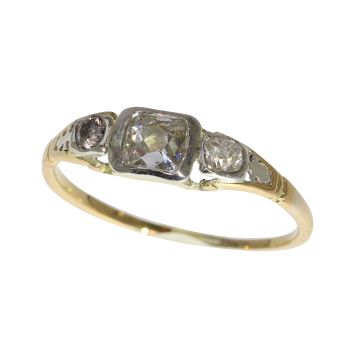
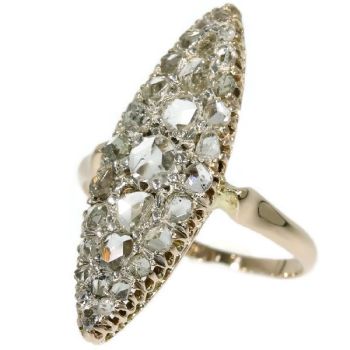
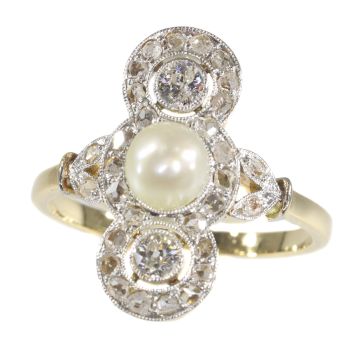
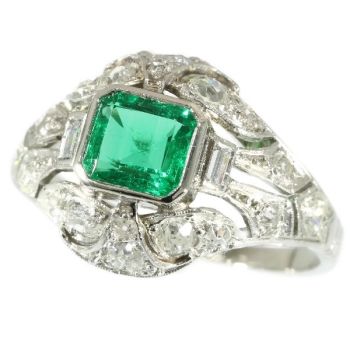
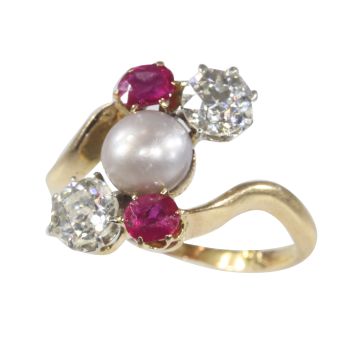
Timeless elegance encapsulates this vintage Belle Époque engagement ring from circa 1920, a symbol of profound love and commitment. Merging Art Deco's geometric precision with Belle Époque's romantic allure, it is crafted in a dual-tone palette of 14Kyellowish/reddish gold and platinum. The ring features a captivating crossover design, showcasing a trio of old mine brilliant cut diamonds, with the primary gemstones weighing approximately 1.00ct, complemented by eight additional diamonds totallingabout 1.52ct. This piece is not just jewellery; it is a declaration of love, designed to express the depth of your affection in an era where glamour and sophistication were paramount.
Antique jewelry object group Love Across Time: 1920s Belle Époque Diamond Statement Ring
Condition very good condition more info on our condition scale
Country of origin unknown
Style Something between Art Deco and Belle Époque - Art Deco is an eclectic artistic and design style which had its origins in Paris in the first decades of the 20th century. The style originated in the 1920s and continued to be employed until afterWorld War II. The term "art deco" first saw wide use after an exhibition in 1966, referring to the 1925 Exposition Internationale des Arts Décoratifs et Industriels Modernes that was the culmination of high-end style modern in Paris. Led by thebest designers in the decorative arts such as fashion, and interior design, Art Deco affected all areas of design throughout the 1920s and 1930s, including architecture and industrial design, as well as the visual arts such as painting, the graphic artsand film. At the time, this style was seen as elegant, glamorous, functional and modern. See also: Art Deco.
And the Belle Époque (French for "Beautiful Era") was a period in European social history that began during the late 19th century and lasted until World War I. Occurring during the time of the French Third Republic and the German Empire, the"Belle Époque" was named in retrospect, when it began to be considered a "golden age" the major powers of Europe, new technologies improved lives and the commercial arts adapted Renaissance and eighteenth-century styles to modern forms. In thenewly rich United States, emerging from the Panic of 1873, the comparable epoch was dubbed the Gilded Age. In the United Kingdom, this epoch overlaps the end of what is called the Victorian Era there and the period named the Edwardian Era. more info on styles
Style specifics This is something between Belle Époque and Art Deco. The Belle Époque (French for "Beautiful Era") was a period in European social history that began during the late 19th century from the Franco-Prussian War (1870-1871) and lasted until World War I (1914-18).
Occurring during the time of the French Third Republic and the German Empire, the "Belle Époque" was named in retrospect, when it began to be considered a "golden age" the major powers of Europe, new technologies improved lives and the commercialarts adapted Renaissance and eighteenth-century styles to modern forms.
In the newly rich United States, emerging from the Panic of 1873, the comparable epoch was dubbed the Gilded Age. In the United Kingdom, this epoch overlaps the end of what is called the Victorian Era there and the period named the Edwardian Era.
In the Belle Époque cheap coal and cheap labour contributed to the cult of the orchid and made possible the perfection of fruits grown under glass, as the apparatus of state dinners extended to the upper classes; champagne was perfected during the Belle Époque. Exotic feathers and furs were more prominently featured in fashion than ever before, as haute couture was invented in Paris, the centre of the Belle Époque, where fashion began to move in a yearly cycle; in Paris restaurantssuch as Maxim's achieved a new splendour and cachet as places for the rich to parade, and the Opéra Garnier devoted enormous spaces to staircases as similar show places.
After mid-century, railways linked all the major cities of Europe to spa towns like Biarritz and Deauville; their carriages were rigorously divided into first-class and second-class, but the super-rich now began to commission private railway coaches, asexclusivity was a hallmark of opulent luxury. Bohemian lifestyles gained a different glamour, pursued in the cabarets of Montmartre.
Art Deco Abstract motives and geometrical forms are quite typical for the Art Deco period. Art Deco moved away from the soft pastels and organic forms of its style predecessor, Art Nouveau, and embraced influences from many different styles and movements of theearly 20th century, including Neoclassical, Constructivism, Cubism, Modernism, and Futurism. Its popularity peaked in Europe during the Roaring Twenties and continued strongly in the United States through the 1930s. Although many design movements havepolitical or philosophical roots or intentions, Art Deco was purely decorative.
Period ca. 1920 Events & facts of this era, poetry of this era, fashion of this era.
Material Two tones of precious metal, the main part being 14K warm yellowish/reddish gold and the white part is platinum. (touchstone tested) more info on precious metals
Extra information Diamond is the birthstone for the month of April, and besides being the most popular gemstone for engagement rings, it is also the anniversary gem for the 10th and 60th years of marriage.
Even though the diamond is the hardest of all gemstones known to man, it is the simplest in composition: it is common carbon. The ancient Greeks believed that diamonds were splinters of stars fallen to earth. It was even said by some that they were thetears of the Gods or perhaps crystallized lightning or hardened dew drops. The exact origin of diamonds remained something of a mystery for centuries.
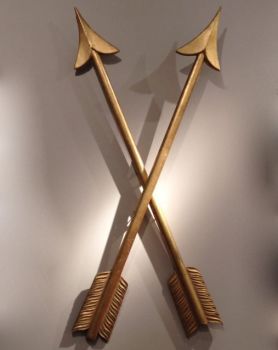
In ancient times only kings wore diamonds as a symbol of strength, courage and invincibility. Over the centuries, the diamond acquired its unique status as the ultimate gift of love. It was said that Cupid's arrows were tipped with diamonds which have amagic that nothing else can ever quite equal.
But it wasn't until 1477, when Archduke Maximillian of Austria gave a diamond ring to Mary of Burgundy, that the tradition of diamond engagement rings began. Even the reason a woman wears it on the third finger of her left hand dates back to the earlyEgyptian belief that the vena amoris (vein of love) ran directly from the heart to the top of the third finger, left hand.
Diamonds Three old mine brilliant cut diamonds with an estimated weight of ± 1.00ct Eight old mine brilliant cut diamonds with an estimated weight of ± 0.52ct
Total diamond count Eleven pcs.
Total diamond weight approx. 1.52 crtwith an average colour and clarity F/I, vs/si
All diamond weights, color grades and clarity are approximate since stones are not removed from their mounts to preserve the integrity of the setting. All diamonds we offer are screened by the I.J.G.C. for whether they are natural or synthetic, and all diamonds in this jewel are 100% guaranteed to be natural.
Birthstones Diamond is the birthstone (or month stone) for April. more info on birthstones
Hallmarks No trace. more info on hallmarks
Dimensions band width top of ring 1,10 cm (0,43 inch) see picture with a ruler in millimeters and inches
Può succedere che un artista o un creatore sia sconosciuto.
Alcune opere non sono determinate da chi sono state realizzate o sono state realizzate da (un gruppo di) artigiani. Esempi sono statue dell'antichità, mobili, specchi o firme non chiare o leggibili ma anche alcune opere non sono affatto firmate.
Inoltre puoi trovare la seguente descrizione:
•"Attribuito a …." A loro avviso probabilmente opera dell'artista, almeno in parte
•“Studio di ….” o “Officina di” A loro avviso un'opera eseguita nello studio o nella bottega dell'artista, eventualmente sotto la sua supervisione
•“Cerchio di…” A loro avviso un'opera del periodo dell'artista che mostra la sua influenza, strettamente legata all'artista ma non necessariamente al suo allievo
•"Stile di..." o "Seguace di..." A loro avviso un'opera eseguita nello stile dell'artista ma non necessariamente da un allievo; può essere contemporaneo o quasi contemporaneo
•“Modalità di…” A loro avviso un'opera nello stile dell'artista ma di epoca successiva
•"Dopo …." A loro avviso una copia (di qualsiasi data) di un'opera dell'artista
•“Firmato…”, “Datato…” o “Iscritto” A loro avviso l'opera è stata firmata/datata/inscritta dall'artista. L'aggiunta di un punto interrogativo indica un elemento di dubbio
•"Con firma....", "Con data...", "Con iscrizione..." o “Riporta firma/data/iscrizione” a loro avviso la firma/data/iscrizione è stata aggiunta da qualcuno diverso dall'artista
Sei interessato ad acquistare questa opera d'arte?