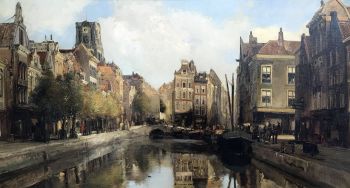
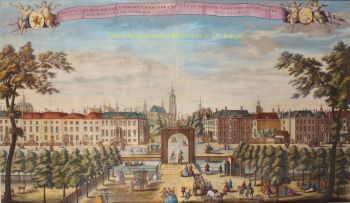
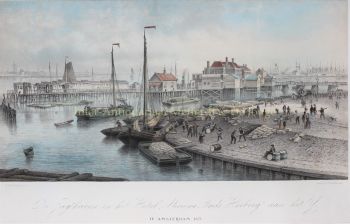
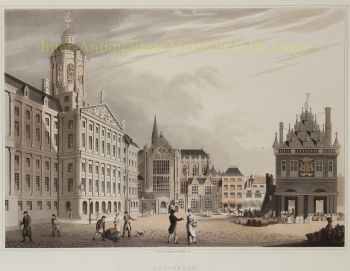
De Beurs en beursbrug te Rotterdam by Artista Sconosciuto
Scroll to zoom, click for slideshow

De Beurs en beursbrug te Rotterdam 1840

Artista Sconosciuto

53 ⨯ 65 cm
€ 1.250

Inter-Antiquariaat Mefferdt & De Jonge

  • A proposito di opere d'arte
    “De Beurs en beursbrug te Rotterdam”, rare lithograph made around 1840 by Jacob Josephus van Rijckevorsel (1785-1862). Coloured by a later hand. Size: 53,5 x 65,6 cm. We see the Blaak (canal) with the Zuidblaak, the Beurs [exchange] and the Beursbrug [exchange bridge] (built in 1826 to replace the old double-beam drawbridge). The streets are not very busy. A merchant unloads his ship, part of his goods have been loaded onto a sled. He quarrels with a vegetable seller. More than ten years before the exhange of Hendrick de Keyser was built n Amsterdam - in 1598 to be precise - Rotterdam already had an exchange on the Haringvliet. There was mainly trade in goods. Lack of space meant that trade moved to the Noordblaak in 1635. From 1736, the trade took place in a new building building designed by architect Adriaen van der Werff on Westnieuwland, on the north bank of the Blaak. The square in front of the eastern entrance became the Beursplein. It was said that the Rotterdam exchange was the most beautiful in Holland, perhaps even the most beautiful in all of Europe. In 1867 the building was given a glass roof after the example of London's Crystal Palace. In 1877, the Rotterdam Beurs train station was opened across the Beursplein as part of the Luchtspoor Breda-Rotterdam railway line. The building was destroyed on 14 May 1940 during the bombing of Rotterdam. Price: Euro 1.250,-
  • A proposito di opere artista

    Può succedere che un artista o un creatore sia sconosciuto.

    Alcune opere non sono determinate da chi sono state realizzate o sono state realizzate da (un gruppo di) artigiani. Esempi sono statue dell'antichità, mobili, specchi o firme non chiare o leggibili ma anche alcune opere non sono affatto firmate.

    Inoltre puoi trovare la seguente descrizione:

    •"Attribuito a …." A loro avviso probabilmente opera dell'artista, almeno in parte

    •“Studio di ….” o “Officina di” A loro avviso un'opera eseguita nello studio o nella bottega dell'artista, eventualmente sotto la sua supervisione

    •“Cerchio di…” A loro avviso un'opera del periodo dell'artista che mostra la sua influenza, strettamente legata all'artista ma non necessariamente al suo allievo

    •"Stile di..." o "Seguace di..." A loro avviso un'opera eseguita nello stile dell'artista ma non necessariamente da un allievo; può essere contemporaneo o quasi contemporaneo

    •“Modalità di…” A loro avviso un'opera nello stile dell'artista ma di epoca successiva

    •"Dopo …." A loro avviso una copia (di qualsiasi data) di un'opera dell'artista

    •“Firmato…”, “Datato…” o “Iscritto” A loro avviso l'opera è stata firmata/datata/inscritta dall'artista. L'aggiunta di un punto interrogativo indica un elemento di dubbio

    •"Con firma....", "Con data...", "Con iscrizione..." o “Riporta firma/data/iscrizione” a loro avviso la firma/data/iscrizione è stata aggiunta da qualcuno diverso dall'artista

Sei interessato ad acquistare questa opera d'arte?
Artwork details