North America - Pierre Mariette + Guillaume Sanson by Artiste Inconnu
Scroll to zoom, click for slideshow

North America - Pierre Mariette + Guillaume Sanson 1669

Artiste Inconnu

Papier
40 ⨯ 55 cm
€ 2.750

Inter-Antiquariaat Mefferdt & De Jonge

  • Sur l'oeuvre d'art
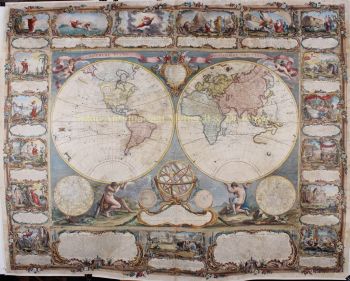
    Amerique Septentrionale Copper engraving made by Pierre Mariette and published by Guillaume Sanson in 1669 after the death of Guillaume's father, Nicolas, in 1667. Coloured by a later hand. Size: 40 x 55 cm. It is a reduced-size copy of Nicolas Sanson's four-sheet wall map of North America, published in 1666, which survives in only two known examples (one dated 1666, one dated 1667). However, this map has changed as compared to its wall-map predecessor. It includes C. Blanco in California and adds R. de Nort, or the Hudson River. The shape of Iceland and the British Isles are also new. The continent is tightly framed, with only a small part of northern South America visible. California is shown as an island, in the form originating from British explorer Luke Foxe's map published in 1635. The northwest of the continent is empty and obscured by the decorative cartouche. In the northeast, Greenland appears connected to North America. New North Wales seemingly floats in northern Hudson’s Bay, giving way to another coastline, New Denmark. This trails southwest-ward to a Mer Glaciale—the dream of a Northwest Passage is alive and well on this map. Much of this configuration is inspired by Thomas Button’s trip to Hudson’s Bay in 1612-3, when he named Port Nelson and Ne Ultra. Button’s Bay is named for him. Luke Foxe, on another voyage seeking the passage in 1631, named the area New Wales. The center of the continent is dominated by Quivira. This toponym refers to the Seven Cities of Gold sought by the Spanish explorer Francisco Vasquez de Coronado in 1541. In 1539, Coronado wandered over what today is Arizona and New Mexico, eventually heading to what is now Kansas to find the supposedly rich city of Quivira. Although he never found the cities or the gold, the name stuck on maps of southwest North America, wandering from east to west. Literature: Philip Burden, The Mapping of North America (1996), nr. 404. Price: Euro 2.750,-
  • Sur l'artiste

    Il peut arriver qu'un artiste ou un créateur soit inconnu.

    Certaines œuvres ne doivent pas être déterminées par qui elles sont faites ou elles sont faites par (un groupe d') artisans. Les exemples sont des statues de l'Antiquité, des meubles, des miroirs ou des signatures qui ne sont pas claires ou lisibles, mais aussi certaines œuvres ne sont pas signées du tout.

    Vous pouvez également trouver la description suivante :

    •"Attribué à …." A leur avis probablement une oeuvre de l'artiste, au moins en partie

    •« Atelier de …. ou « Atelier de » À leur avis, une œuvre exécutée dans l'atelier ou l'atelier de l'artiste, éventuellement sous sa direction

    •« Cercle de… ». A leur avis une oeuvre de la période de l'artiste témoignant de son influence, étroitement associée à l'artiste mais pas forcément son élève

    •« Style de … ». ou "Suiveur de ...." Selon eux, une œuvre exécutée dans le style de l'artiste mais pas nécessairement par un élève ; peut être contemporain ou presque contemporain

    •« Manière de… ». A leur avis une oeuvre dans le style de l'artiste mais d'une date plus tardive

    •"Après …." A leur avis une copie (quelle qu'en soit la date) d'une oeuvre de l'artiste

    •« Signé… », « Daté… ». ou « Inscrit » À leur avis, l'œuvre a été signée/datée/inscrite par l'artiste. L'ajout d'un point d'interrogation indique un élément de doute

    • "Avec signature ….", "Avec date ….", "Avec inscription …." ou "Porte signature/date/inscription" à leur avis la signature/date/inscription a été ajoutée par quelqu'un d'autre que l'artiste

Êtes-vous intéressé par l'achat de cette oeuvre?

Artwork details