A pair of Dutch Colonial Solid Satinwood Chairs, Ceylon 18th century by Artista Desconhecido

A pair of Dutch Colonial Solid Satinwood Chairs, Ceylon 18th century 1725 - 1750

Artista Desconhecido

101 ⨯ 75 ⨯ 50 cm
ConditionGood
Preço em pedido

Menken Works of Art

  • Sobre arte
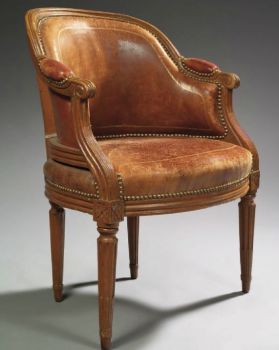
    A pair of Dutch colonial solid satinwood chairs.
    Galle, Ceylon (Sri Lanka), c. 1725-1750.

    The chairs are richly carved, featuring a shell motif at the crest of the backrest, flanked by two birds with open lion-like mouths. Furthermore with floral and acanthus leaf carvings, shell motifs, and claw feet.

    Crafted from Ceylon Satinwood (Chloroxylon swietenia), these chairs were most likely made by Sinhalese artisans in the Black Town (Pettah) district of Colombo during the VOC (Dutch East India Company) period in Dutch Ceylon (1664–1795).

    Such satinwood furniture, reflecting Dutch stylistic preferences, was favored by both Europeans and affluent Sinhalese families. While the overall form and decorative elements are inspired by 18th-century European models, the incorporation of carved birds—identified by R.L. Brohier as Garuda, the eagle mount of Vishnu—and the detailed carving reflect distinctive Sinhalese craftsmanship.

    Dimensions:
    Height 101 cm, width 75 cm, depth 50 cm, seat height 44 cm.

    Condition report and more pictures available upon request.

    Ref:
    An identical chair can be found in the Asian Civilisations Museum, Singapore (accession number 2015-00480).

    Also compare with a pair of chairs of the same design but with a different stretcher underneath the seating in the Cleveland Museum of Art (accession number 1922.677).

    Another similar chair, but with red and gold lacquer-work is in the Museum Sejarah Jakarta and illustrated in Furniture From Indonesia, Sri Lanka and India (Jan Veenendaal, 1985), p. 100, pl. 108.

    Other identical examples can be found in the Wolvendaal (Dutch Reformed) Church in Colombo, Sri Lanka and illustrated in situ in Furniture of the Dutch Period in Ceylon (R.L. Brohier, 1969), p. 14, fig. 14 and pl. X|||, fig. 4.

    Furthermore an identical chair is illustrated in Asian Art and the Dutch Taste (Jan Veenendaal, 2014), p. 63, pl. 92.

    Inv. No: MW270
  • Sobre artista

    Pode acontecer que um artista ou criador seja desconhecido.

    Algumas obras não devem ser determinadas por quem são feitas ou são feitas por (um grupo de) artesãos. Exemplos são estátuas dos tempos antigos, móveis, espelhos ou assinaturas que não são claras ou legíveis, mas também algumas obras não são assinadas.

    Além disso, você pode encontrar a seguinte descrição:

    •"Atribuído a …." Na opinião deles, provavelmente uma obra do artista, pelo menos em parte

    • “Estúdio de…” ou “Oficina de” Em sua opinião um trabalho executado no estúdio ou oficina do artista, possivelmente sob sua supervisão

    • "Círculo de ..." Na opinião deles, uma obra da época do artista mostrando sua influência, intimamente associada ao artista, mas não necessariamente seu aluno

    •“Estilo de…” ou “Seguidor de…” Na opinião deles, um trabalho executado no estilo do artista, mas não necessariamente por um aluno; pode ser contemporâneo ou quase contemporâneo

    • "Maneira de ..." Na opinião deles, uma obra no estilo do artista, mas de data posterior

    •"Depois …." Na opinião deles uma cópia (de qualquer data) de uma obra do artista

    • “Assinado…”, “Datado…” ou “Inscrito” Na opinião deles, a obra foi assinada/datada/inscrita pelo artista. A adição de um ponto de interrogação indica um elemento de dúvida

    • "Com assinatura ….”, “Com data ….”, “Com inscrição ….” ou “Tem assinatura/data/inscrição” na opinião deles a assinatura/data/inscrição foi adicionada por outra pessoa que não o artista

Você está interessado em comprar esta obra de arte?