1950s Platinum Brooch with Blue Zircon – Refined Mid-Century Geometry by Onbekende Kunstenaar

1950s Platinum Brooch with Blue Zircon – Refined Mid-Century Geometry 1950

Onbekende Kunstenaar

DiamantZirconEdelsteenPlatina
€ 4.750

Adin Fine Antique Jewellery

  • Over kunstwerk

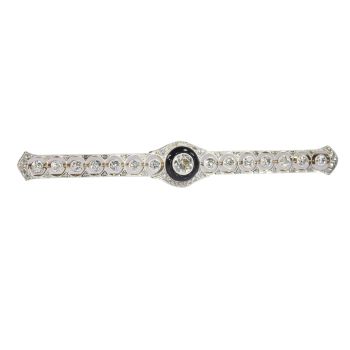
    This platinum brooch from the 1950s features a natural blue zircon, also known as starlite, weighing approximately 7.70ct. The round zircon is set in an octagonal bezel and flanked by stepped shoulders set with diamonds. The geometric design, cleanlines and open gallery work are typical of mid-century style, combining structure with a touch of colour. Solidly made yet elegant, it reflects the post-war taste for refined modern forms.

    Antique jewelry object group
    brooch/pin

    Condition
    very good condition
    more info on our condition scale

    Style
    Although most people would call this style Art Deco it is more considered to be a product of the fifties of the Twentieth Century. Strongly influenced by Art Deco but also by the Retro style. That to most people this is Art Deco is no coincidence as both Retro style and Fifties style are the style successors of Art Deco.
    more info on styles

    Style specifics
    This type of jewelry is very specific for the fifties of the twentieth century. The Art Deco period preceded only 20 years and was still used as source of inspiration, it is (even for the trained eye) sometimes very hard to note the difference betweenArt Deco and Fifties.

    Period
    ca. 1950
    Events & facts of this era, poetry of this era, fashion of this era.

    Material
    platinum (touchstone tested)
    more info on precious metals

    Diamonds
    Fourteen single brilliant cut diamonds (also called 8/8)with an estimated weight of ± 0.38ct colour and clarity G/I, vs/si
    - When we provide weights, colour grades, and clarity of diamonds, these are approximate unless otherwise stated, as we do not remove diamonds from their settings to preserve the integrity of the piece.

    - We do not sell lab-grown (synthetic) diamonds.

    Precious stones
    One natural blue zircon, also called starlite with an estimated weight of ± 7.70ct
    All color stone weights are approximate since stones are not removed from their mounts to preserve the integrity of the setting.
    It is a very common practice to treat gemstones to intensify their clarity or colour. The item in question has not been tested in this regard.

    Birthstones
    Diamond is the birthstone (or month stone) for April and zircon for December.
    more info on birthstones

    Hallmarks
    No trace.
    more info on hallmarks

    Dimensions
    2,56 cm (1,01 inch) x 1,18 cm (0,46 inch)
    see picture with a ruler in millimeters and inches

    Weight
    6,70 gram (4,31 dwt)

    Adin Reference Nº
    25115-0286

    Copyright photography
    Adin, fine antique jewellery

    Additional information
    our latest acquisitions
    jewelry glossary
    wall of fame
    visit us in Antwerp
    subscribe to our mailinglist

  • Over kunstenaar

    Het kan voorkomen dat een kunstenaar of maker onbekend is.

    Voor sommige werken is het niet te bepalen door wie het gemaakt is of dat het is gemaakt door (een groep) ambachtslieden. Voorbeelden zijn beelden uit de Oudheid, meubels, spiegels of handtekeningen die vaak niet duidelijk of leesbaar zijn. Maar ook sommige werken zijn helemaal niet gesigneerd.

    Ook kunt u de volgende beschrijving vinden:

    •"Toegeschreven aan …." waarschijnlijk een werk van de kunstenaar maar niet zeker of gedeeltelijk

    •“Atelier van ….” of werkplaats van” een werk uitgevoerd in het atelier of atelier van de kunstenaar, eventueel onder zijn toezicht

    •“Cirkel van ….” een werk uit de periode van de kunstenaar die zijn invloed laat zien, nauw verbonden met de kunstenaar maar niet noodzakelijkerwijs zijn leerling

    •“Stijl van ….” of  “Volger van ….” een werk uitgevoerd in de stijl van de kunstenaar, maar niet noodzakelijk door een leerling; kan eigentijds of bijna eigentijds zijn

    •“Wijze van ….” een werk in de stijl van de kunstenaar maar van latere datum

    •"Na …." een kopie (van welke datum dan ook) van een werk van de kunstenaar

    •“Getekend…”,  “Gedateerd….”  of  “Ingeschreven” dan is het werk gesigneerd/ gedateerd/ ingeschreven door de kunstenaar. De toevoeging van een vraagteken duidt op een element van twijfel

    •"Met handtekening ...", "Met datum ...", "Met opschrift..." of “Draagt signatuur/datum/opschrift” dan is de handtekening/datum/opschrift toegevoegd door iemand anders dan de kunstenaar

Bent u geïnteresseerd om dit kunstwerk te kopen?